July 18, 2025
DRLV aircraft, Pbv 302 APCs, Archer self-propelled guns, and CB90 combat boats: Sweden's Support for Ukraine
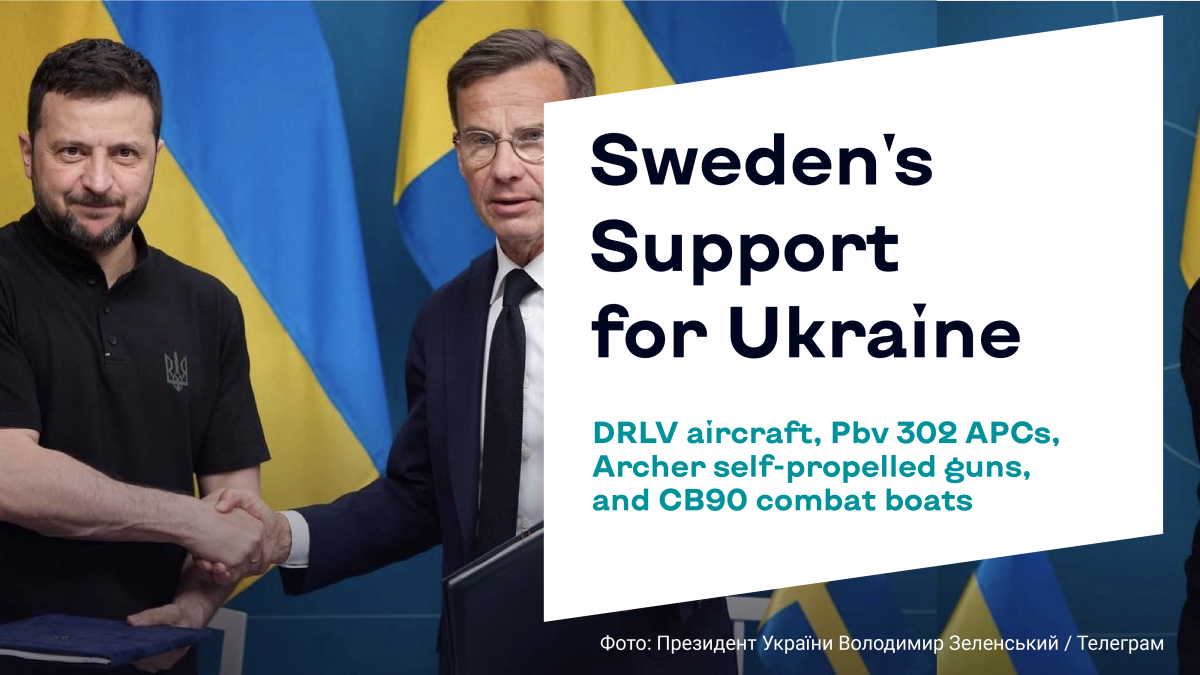
by Dariia Cherniavska
A year has passed since the signing of the bilateral security agreement with Sweden – the Agreement on Security Cooperation between Ukraine and Sweden.
This agreement, signed on May 31, 2024, became the thirteenth in a series of bilateral security agreements that Ukraine began to conclude on January 12, 2024 as part of the formalization of the Joint Declaration of Support for Ukraine, signed on July 12, 2023 by the countries of the “Group of Seven” (G7). Prior to this, Ukraine concluded similar agreements with the United Kingdom, France, Germany, Denmark, Canada, Italy, the Netherlands, Finland, Latvia, Spain, Belgium, and Portugal.
As of May 31, 2025, Ukraine had signed a total of 29 bilateral cooperation agreements, including 27 agreements with the signatory states of the Joint Declaration, 1 agreement with the EU, and 1 agreement with Croatia, which did not join the Joint Declaration.
All security agreements within this series are signed for 10 years and provide for comprehensive support to Ukraine from the partner states. In particular, these include providing Ukraine with weapons and military equipment for self-defense in the war with Russia, cooperation in the defense-industrial complex, conducting exercises for the Ukrainian military on the territory of the partner states, humanitarian support, strengthening cybersecurity, restoring energy infrastructure, increasing sanctions pressure on Russia, and holding the aggressor accountable.
What commitments did Sweden make under the security agreement?
The provisions of the security agreement with Sweden provide for comprehensive 10-year cooperation in areas that can be summarized in 10 topics:
- Provision of weapons and military equipment to Ukraine.
- Cooperation in the defense-industrial complex.
- Use of frozen Russian assets to support Ukraine.
- Training of Ukrainian military personnel.
- Sanctions against Russia and its supporters.
- Non-military security and civil protection.
- Demining of Ukrainian territories.
- Support for energy infrastructure.
- Humanitarian support and support for the reconstruction of Ukraine.
- Holding Russia accountable.
Sweden's military support commitments provide for the allocation of 6.5 billion euros for weapons and military equipment for Ukraine during 2024-2026. Priority areas of defense cooperation between the countries are air defense, maritime security, and Ukraine's artillery and drone capabilities.
To strengthen Ukraine's defense capabilities, Sweden has additionally committed to contributing to the development of the Ukrainian defense industry and participating in the training of Ukrainian military personnel in multilateral missions.
Two other important blocks of the security agreement are the path to a just peace and humanitarian assistance to Ukraine. The first block includes increasing sanctions pressure on Russia and its supporters, finding legal ways to use frozen Russian assets to support Ukraine, and holding the Russian Federation accountable for its illegal actions against Ukraine, including through the establishment of a tribunal. The second block provides for Sweden's multifaceted contributions to the humanitarian demining of Ukrainian territories, the protection of critical infrastructure, and the long-term reconstruction of Ukraine. In particular, Sweden has pledged to allocate more than 500 million euros for cooperation with Ukraine in the field of reconstruction during 2023-2027.
Implementation of the agreement: what assistance and in what amounts has Sweden provided to Ukraine over the past year?
Sweden became one of the few countries that, during the first year of implementation of the security agreement with Ukraine, actively and comprehensively fulfilled all its commitments in the 10 areas stipulated by the provisions of the agreement.
Military support
From May 2024 to May 2025, Sweden announced 4 comprehensive packages of military assistance to Ukraine for a total amount of over 4.5 billion US dollars.
As part of these defense packages, Sweden has pledged to provide Ukraine with 2 Saab 340 AEW&C (ASC 890) AWACS aircraft for long-range target identification and strengthening of Ukrainian air defense capabilities, all of its Pansarbandvagn 302 armored personnel carriers with ammunition, 22 Combat Boat 90 combat boats, Robot System 70 MANPADS, AT4 grenade launchers, ammunition for CV90 infantry fighting vehicles, at least 1,500 TOW anti-tank missiles and other weapons.
At the same time, Ukraine has not received all of the military support announced by Sweden. For example, Sweden has not yet provided Ukraine with 2 AWACS aircraft, the provision of which was officially announced on May 29, 2024 as part of the 16th defense package for Ukraine. The Swedish Ministry of Defense explained that the long wait for these aircraft is due to the preparation by other partner states of some modifications of F-16 fighters for interaction with them.
Sweden has also joined many coalitions of capabilities, in particular the Drone Coalition. Within the framework of this collective mechanism, during the year of implementation of the security agreement, Sweden, together with the United Kingdom, Denmark, the Netherlands and Latvia, financed the production and purchase of 30 thousand drones for the needs of the Ukrainian Defense Forces for the amount of 55 million US dollars. In particular, within the framework of the 18th and 19th military assistance packages for Ukraine alone, Sweden made a financial contribution of more than 35 million US dollars to the development of the Drone Coalition.
Additionally, Sweden has strengthened Ukraine's artillery capabilities. As part of the 18th defense package announced at the end of January 2025, Sweden signed a contract for the production and supply of 18 Archer self-propelled guns and 5 ARTHUR counter-battery radars to Ukraine for almost 300 million US dollars. Also, at the end of May 2025, Sweden announced the allocation of about 60 million US dollars for the purchase of ammunition for Ukraine, in particular as part of the “Czech initiative” - a program for the purchase and supply of 155-mm artillery shells to Ukraine.
Defense assistance from Sweden will continue to flow at least until the end of 2026, as Sweden has already committed to allocate more than 2.5 billion US dollars annually for military support to Ukraine.
Cooperation in the defense industry
Sweden is one of the countries that is most actively strengthening the defense industry of Ukraine.
Thus, during the first year of implementing the security agreement, Sweden allocated more than 300 million US dollars for the production of weapons in Ukraine within the framework of the “Danish model” — a program of direct financial contributions to the defense industry of Ukraine from partner states led by Denmark. Of this amount, Sweden directed at least 180 million US dollars to the production of long-range missiles and drones. This financial contribution not only strengthens Ukraine’s defense capabilities, but also makes it possible to strike legitimate targets on the territory of Russia.
During this year, Ukraine also significantly deepened cooperation with a number of defense companies in Sweden.
At the end of September 2024, the Swedish defense company Saab, which specializes in aircraft construction and radar technologies, announced the future establishment of production in Ukraine. In 6 months – in March 2025 – the Ukrainian defense company Radionics signed a memorandum with Saab on establishing a strategic partnership in the field of military electronics for the joint development and maintenance of sensor systems.
Another Swedish defense company that regularly strengthens Ukraine is the military equipment manufacturer BAE Systems Hägglunds. In December 2024, the governments of Sweden and Denmark signed a contract with this company for the production of 40 CV90 infantry fighting vehicles for the needs of the Ukrainian Defense Forces. At the end of May 2024, the Swedish government had already ordered BAE Systems Hägglunds to produce CV90 infantry fighting vehicles for Ukraine, so the support from this company remains constant.
In addition, last year Ukraine established cooperation with the Swedish ammunition manufacturer Nammo. Since January 2024, this defense plant has been involved in the production and supply of 155-mm artillery shells to Ukraine.
Using frozen Russian assets to support Ukraine
Sweden has joined the collective initiatives of the European Union to use frozen Russian assets to support Ukraine.
For the first time, the EU has adopted a number of legal acts to enable the transfer of profits from frozen Russian assets to Ukraine in late spring 2024.
A few months later – in July – the European Commission announced the provision of the first tranche of 1.5 billion euros to Ukraine from the proceeds of frozen Russian assets. These funds were allocated to military assistance, in particular for the purchase of air defense and artillery shells, as well as for investments in the Ukrainian defense industry.
At the end of October, the EU approved a decision to provide Ukraine with a loan of up to 35 billion euros as part of the G7 “Extraordinary Revenue Acceleration Loans for Ukraine” (ERA) program. This program was initiated by the G7 countries and provides for the provision of 50 billion US dollars in credit funds to Ukraine from the proceeds of frozen Russian assets, in particular the assets of the Central Bank of Russia.
As of May 31, 2025, Ukraine has already received 4 tranches from the EU for the amount of 6 billion euros under the ERA program. The first tranche of 3 billion euros was received by Ukraine in January, and the second, third and fourth tranches of 1 billion euros each – at the end of March, at the beginning of April and at the beginning of May, respectively. The EU allocated these funds to cover Ukraine’s priority budget expenditures.
In addition, on May 9, the EU High Representative and EU ministers signed a statement in Lviv on their intention to transfer an additional 1 billion euros in proceeds from frozen Russian assets to Ukraine. The EU will allocate these funds to the purchase of weapons from the Ukrainian defense industry. Ukrainian Prime Minister Denys Shmyhal announced that the EU will allocate a total of 1.9 billion euros from the proceeds of frozen Russian assets to strengthen Ukraine’s defense capabilities. In addition to contributions to the Ukrainian defense industry, over 600 million euros will be allocated to the purchase of artillery and ammunition, and over 200 million euros to strengthen Ukraine’s air defense. This will be the second such EU contribution to the purchase of weapons for Ukraine, following the 1.5 billion euros contribution in July.
In total, the EU plans to transfer to Ukraine the announced 35 billion euros under the G7 ERA initiative and the Ukraine Facility program in 2025, of which about 18 billion euros will be disbursed under the ERA program.
Training of the Ukrainian military
Sweden has joined the two largest collective missions for the training of Ukrainian military personnel - the EU training mission EUMAM Ukraine and the multinational training operation INTERFLEX.
Within the 18th defense package for Ukraine alone, Sweden has allocated about 70 million US dollars for participation in training missions, in particular, for the organization of basic combined arms training for the Ukrainian military within the framework of the INTERFLEX program in 2025. In total, as of this year, Swedish instructors will conduct training for more than 18,000 Ukrainians.
Thus, Sweden will continue to train Ukrainian operators and technicians to use the transferred Swedish military equipment, in particular the CV90 infantry fighting vehicle, the Archer self-propelled gun and the Combat Boat 90 combat boats. Additionally, Swedish instructors are involved in conducting medical training and exercises for infantry battalions within the framework of EUMAM Ukraine.
In addition, in early spring 2025, Sweden, together with other Baltic and Scandinavian countries, began training the "Nordic-Baltic Brigade" of the Armed Forces of Ukraine, which will number from 3,000 to 5,000 soldiers and consist of 3-4 line battalions.
Sanctions against Russia and its supporters
Sweden is stepping up sanctions pressure on Russia as part of the European Union’s comprehensive sanctions packages.
From May 31, 2024 to May 31, 2025, the EU announced 4 comprehensive sanctions packages against Russia and its supporters, which were aimed at the military industry, the energy sector of the Russian Federation, as well as individuals and legal entities responsible for war crimes, in particular for the deportation of Ukrainian children.
During this year, 342 vessels of the Russian “shadow fleet”, a chemical plant, Russian defense and shipping companies, an important Russian oil shipping company, Surgutnaftogaz, the military unit responsible for the shelling of the Okhmatdyt children’s hospital in Kyiv, propaganda media, as well as top managers of leading Russian companies in the energy sector fell under EU sanctions.
Additionally, the European Union has expanded the ban on transshipment services of Russian liquefied natural gas (LNG) in the EU for transit to third countries, on access to ports for Russian vessels, on flights over EU territory and on exports to Russia of goods that contribute to the strengthening of the Russian defense industry.
A feature of the EU sanctions is that they are designed to increase pressure not only on the Russian Federation directly, but also on Russia's supporters. Therefore, in addition to Russia, China, North Korea, India, the UAE, Singapore, Uzbekistan, Iran, Turkey, Kazakhstan and Serbia were subject to sanctions for supplying Russia with drones or missiles, as well as for assisting in evading sanctions.
Non-military security and civil protection
Sweden has joined two key collective mechanisms to strengthen Ukraine’s cybersecurity – the IT Coalition and the Tallinn Mechanism.
In 2024, the IT Coalition member countries, including Sweden, accumulated 482 million euros to support the Ministry of Defense of Ukraine and the Armed Forces of Ukraine in the field of communications, IT and cybersecurity. And by the end of May 2025, the amount of funds raised for Ukraine within the framework of this collective initiative reached 1.1 billion euros in financial and material forms. These funds are mainly aimed at purchasing secure communications equipment, scaling the DELTA combat system and providing tactical-level control points, data centers, as well as innovation and cybersecurity units with the necessary equipment. Thus, in 2025 alone, Sweden has already allocated more than 3 million US dollars to strengthen the IT coalition, in particular by purchasing equipment for the Ukrainian DELTA system.
In addition, during 2024, Sweden, together with other participants in the Tallinn Mechanism, allocated another 200 million euros to strengthen Ukraine’s cyber resilience, in particular, Ukraine’s ability to resist malicious Russian cyber operations.
Sweden also actively supports the civil protection sector in Ukraine. In July 2024, the Swedish government allocated 1 million US dollars to strengthen the capacity of Ukrainian emergency services and integrate these services into EU standards. In a few months – in September – the Swedish Coast Guard transferred 7 jet skis to Ukraine for water surveillance in addition to the 9 jet skis transferred in March 2024. And in late autumn, Sweden allocated a record 9 million euros to strengthen the capabilities of the Ministry of Internal Affairs units. The aid package included 2 patrol boats for the State Border Guard Service of Ukraine, 24 cars, a minibus, and personal protective equipment for Ukrainian rescuers.
Additionally, thanks to the support of the Swedish government and the United Nations Development Program (UNDP), Ukrainian military ecologists in February 2025 received equipment to assess the degree of danger of soils contaminated with explosive remnants of war. Modern portable MX908 and Raman Serstech Arx spectrometers are designed to facilitate the identification of chemical threats in the studied areas and accelerate the provision of environmental safety.
Demining Ukrainian territories
Sweden joined the Demining Coalition, within the framework of which 22 participating countries managed to accumulate over 50 million euros in 2024 for demining Ukrainian territories, as well as transfer to Ukraine 200 units of specialized automotive equipment for demining, 100 complexes for overcoming mine and explosive barriers, 41 armored vehicles and 330 mine detectors. And in February 2025, the Demining Coalition announced the allocation of 700 million euros for the purchase of equipment for demining Ukrainian territories by 2034, of which 130 million euros will be allocated by the participating countries for these needs already in 2025.
Since joining the Coalition in September 2024 until May 31, 2025, Sweden has allocated more than 25 million euros for the needs of demining Ukrainian territories, in particular for the purchase of mine detectors, demining vehicles and personal protective equipment.
Sweden has also made a significant contribution to conducting mine action exercises. In June 2024, the Swedish government allocated 9 million US dollars to increase the capacity of Ukrainian state institutions to train their own demining units. And in December, Sweden financed a two-week mine action course for disabled veterans, during which participants mastered the MV-10 and "Zmiy" demining machines. This program, organized jointly with UNDP, is designed to simultaneously promote the reintegration of veterans and restore security to communities affected by the war.
In addition, instructors from the Swedish Center for Explosive Ordnance Disposal are participating in the training of Ukrainian demining specialists in Lithuania throughout 2025. As part of this project, the Swedish Armed Forces are to train 48 Ukrainian instructors, who will then train 100 demining soldiers each. In total, it is expected that 4,800 Ukrainian servicemen will acquire the necessary skills for explosive ordnance disposal through this initiative.
Supporting energy infrastructure
Sweden regularly makes significant financial contributions to the restoration of Ukraine’s damaged energy infrastructure.
In 2024 alone, the Swedish government allocated more than 180 million euros to strengthen Ukraine’s energy system, purchase energy equipment, and increase Ukraine’s electricity generation and supply capacity. Of these funds, Sweden has allocated at least 43 million euros to the Ukraine Energy Support Fund, which helps to quickly restore damaged or destroyed energy infrastructure as a result of Russian shelling.
As part of its support for the year, Sweden also financed the installation of two gas turbines for electricity generation to provide electricity to 185,000 Ukrainians and minimize the consequences of Russian attacks, and transferred 13 powerful generators to Ukraine.
And at the end of February 2025, the Swedish government pledged to provide Ukraine with 3 more diesel-fired backup power plants that can supply electricity to small critical infrastructure facilities.
In addition, on March 17, Ukraine and Sweden signed a Memorandum of Understanding on Energy and Green Transition, so the countries will deepen their bilateral partnership in the areas of nuclear safety, reconstruction of the Ukrainian energy system, and the transition to green energy.
Humanitarian support and support for the reconstruction of Ukraine
Providing humanitarian assistance to Ukraine is one of the priority areas of support from Sweden. Thus, Sweden is significantly strengthening the Ukrainian healthcare system.
In particular, in June 2024, more than 500 Ukrainian military medics underwent psychological rehabilitation in Sweden as part of the Repower Charitable foundation project. Another project within the framework of which Sweden accepts Ukrainians for treatment and rehabilitation was the Medevac program, which allows Ukrainian civilians and military personnel affected by the war to undergo treatment in foreign medical clinics, including in Sweden.
A month later - in July - Ukraine signed memoranda with the pharmaceutical agencies of Sweden and Poland to develop medical partnerships and promote the implementation of European standards in the pharmaceutical industry of Ukraine.
In addition, following Russia’s missile strike on the Okhmatdyt Children’s Hospital in Kyiv, the Swedish government, through UNICEF, allocated 500,000 US dollars to support the affected children and families. The Swedish government has also allocated 1 million US dollars to help rebuild the hospital, including purchasing necessary equipment.
This is not Sweden’s first collaboration with the Okhmatdyt Children’s Hospital, as at the end of 2023, Okhmatdyt and Karolinska University Hospital signed a memorandum under which more than 30 Ukrainian doctors will undergo internships at the Astrid Lindgren Children’s Clinic of the Swedish hospital in 2024.
And already on October 15, Ukraine and Sweden signed two more agreements on deepening medical cooperation: a technical agreement in the field of health care within the framework of the bilateral security agreement and a memorandum on international medical partnership between the Rivne Regional Hospital of War Veterans and the Spinalis Foundation in Sweden. This cooperation is designed to strengthen medical ties between the countries and modernize the field of rehabilitation care in Ukraine.
The Swedish government made another contribution to the Ukrainian health care system at the end of November. Sweden allocated more than 5 million US dollars to the United Nations Population Fund (UNFPA) to build a system of maternity wards in Ukraine, protected from possible Russian shelling, and mobile medical clinics in hard-to-reach areas.
Humanitarian assistance from Sweden during the year of implementation of the security agreement was not limited to medical partnership. Thus, in October 2024, the multi-year initiative “Strengthening Municipal Waste Management in Ukraine (2024–2027)”, funded by the Swedish government, began its work. This program should help Ukraine implement a national waste management reform, in particular to achieve EU standards.
And in December, Sweden allocated 11.5 million US dollars to the “Grain from Ukraine” initiative to overcome the global food crisis in the context of the blockade and shelling of Ukrainian ports by Russia.
Another area of support to which Sweden made a significant contribution was reconstruction. In early March 2025, Sweden invested 10.5 million US dollars in the reconstruction and repair of Ukrainian infrastructure, including railways. Sweden, together with Germany, allocated another 17 million euros to strengthen Ukrainian civil society, enhance gender equality, and sustainable development projects.
In addition, Sweden has joined the Ukraine Recovery, Reconstruction and Reform Trust Fund (URTF) organized by the World Bank and, together with 14 other donor countries, has been able to mobilize more than 2 billion US dollars for Ukraine’s recovery and reconstruction since 2022.
In total, Sweden will allocate about 150 million US dollars to strengthen Ukraine’s resilience and recovery during 2025.
Holding Russia accountable
Sweden has joined two key coalitions to hold Russia accountable – the Coalition for the Establishment of a Special Tribunal for the Crime of Aggression against Ukraine and the International Coalition for the Return of Ukrainian Children.
Within the Coalition for the Establishment of a Special Tribunal, Sweden and around 40 partner countries completed the preparation of draft constituent documents necessary for the establishment of a special tribunal on 9 May 2025, after two years of activity, and signed the Joint Statement of the Meeting of Foreign Ministers on the Completion of the Coalition’s Work.
Already on 14 May, Ukraine submitted these draft documents, including the Statute of the Special Tribunal, to the Council of Europe. The next step was the signing on 25 June of a bilateral Agreement between Ukraine and the Council of Europe on the Establishment of a Special Tribunal for the Crime of Aggression against Ukraine.
The tribunal will operate in The Hague, and its jurisdiction will extend to 20-30 people: the highest military-political leadership of Russia, including Putin and Lavrov, as well as the self-proclaimed President of Belarus Alexander Lukashenko. A key feature of the tribunal is that the trial can be held in absentia, which allows for sentences to be passed even without the physical presence of the accused. If convicted, the guilty will face up to 30 years behind bars or life imprisonment. It is expected that the tribunal will be able to begin work as early as 2026.
And within the framework of the International Coalition for the Return of Ukrainian Children, participating countries, including Sweden, were able to return almost 600 children deported by Russia to Ukraine in 2024.
In a separate effort, Sweden provided an additional 2.4 million euros to the European Union Advisory Mission (EUAM) in Ukraine in October 2024 to investigate war crimes committed by Russia on the territory of Ukraine. This financial support was intended to improve Ukraine’s digital justice infrastructure, in particular by implementing the SMEREKA electronic case management system, to accelerate the prosecution of perpetrators.