March 19, 2025
NASAMS Air Defense, ACSV Armored Vehicles and SkyRanger UAVs: Canada's Support for Ukraine
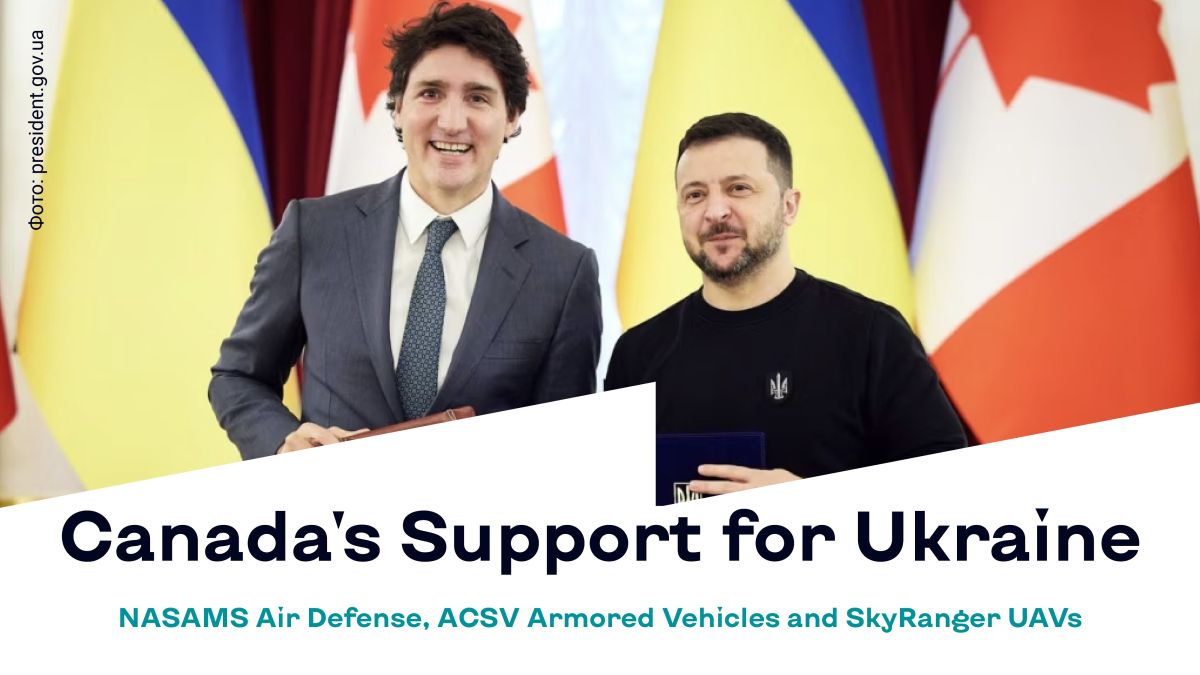
by Dariia Cherniavska
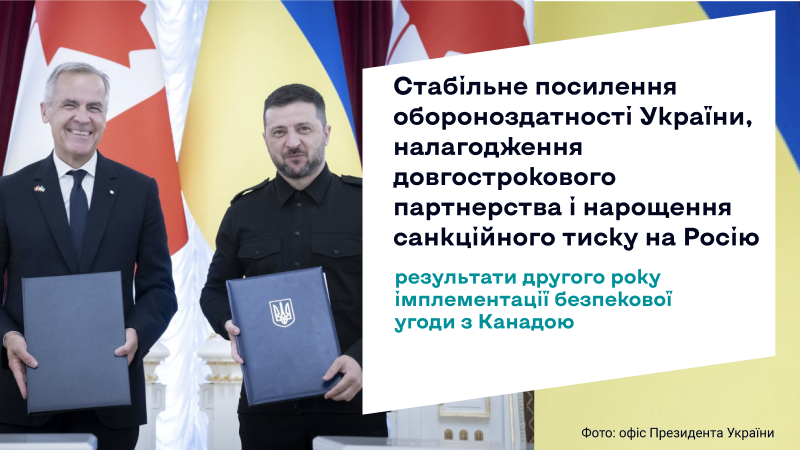
On the second anniversary of Russia's full-scale invasion, on February 24, 2024, Ukraine signed a security agreement with Canada - the Agreement on security cooperation between Ukraine And Canada.
This agreement became the fourth security agreement with a Group of Seven (G7) country after the agreements with the United Kingdom, Germany, and France, and the first security agreement concluded with a country outside Europe as part of the formalization of the Joint Declaration of Support for Ukraine signed by the G7 countries on July 12, 2023.
In total, as of February 24, 2025, Ukraine has already concluded 29 bilateral cooperation agreements, including 27 agreements with the signatories to the Joint Declaration, 1 agreement with the EU, and 1 agreement with Croatia, which has not joined the Joint Declaration.
All of these security agreements are signed for 10 years and provide for the provision of weapons and military equipment to Ukraine for self-defense in the war with Russia, cooperation in the defense industry, training for the Ukrainian military on the territory of partner states, humanitarian support, increased sanctions pressure on Russia and holding the aggressor accountable.
What commitments has Canada made under the signed security agreement
The security agreement with Canada, like other security agreements with G7 countries, contains provisions on comprehensive bilateral cooperation between Ukraine and Canada on 10 points:
- Provision of arms and military equipment to Ukraine.
- Cooperation in the defense industry.
- Use of frozen Russian assets to support Ukraine.
- Training of the Ukrainian military.
- Sanctions against Russia and its supporters.
- Non-military security and civil protection.
- Demining of Ukrainian territories.
- Support for energy infrastructure.
- Humanitarian and reconstruction support for Ukraine.
- Holding Russia accountable.
As part of the agreement, Canada pledged $3.02 billion in military and macroeconomic support to Ukraine through 2024. Military cooperation includes, among other things, Canada's involvement in strengthening Ukraine's defense capabilities in the areas of armor, artillery, and aviation, Canadian investment in the Ukrainian defense industry and the localization of Canadian defense companies in Ukraine, and training for Ukrainian military personnel as part of Operation UNIFIER.
Other important areas of bilateral partnership are the path to a just peace and humanitarian aid for Ukraine. The first area includes strengthening sanctions pressure on Russia and its supporters, finding legal ways to use frozen Russian assets to support Ukraine, and holding the Russian Federation accountable for its illegal actions against Ukraine, including through the establishment of a tribunal. And the second area involves Canada's multifaceted contributions to humanitarian demining of Ukrainian territories, support for the energy sector, and Ukraine's long-term recovery.
Implementation of the agreement: what kind of assistance and how much Canada provided to Ukraine over the year
From February 24, 2024, to February 24, 2025, Canada systematically fulfilled all of its obligations under the security agreement through individual and collective initiatives.
Military support
Over the year of implementation of the security agreement, Canada has provided about $1.4 billion in military assistance to Ukraine.
One of Canada's most significant contributions to strengthening Ukraine's defense capabilities was the provision of a $300 million NASAMS air defense system in late November 2024. To strengthen Ukraine's air defense, Canada has also joined Germany's initiative to strengthen Ukraine's air defense and has allocated more than €50 million for the purchase of missiles for the IRIS-T air defense system.
As part of the Armored Vehicle Coalition, Canada provided Ukraine with up to 10 LAV 6.0 ACSV armored vehicles out of a total of 50 announced by 2026, as well as chassis from 29 M113 APCs and 64 Coyote LAV armored vehicles. On February 24, 2025, Canada announced that it would provide Ukraine with 25 more LAV III infantry fighting vehicles.
In the spring of 2024, Canada joined the Drone Coalition and enhanced Ukraine's drone capabilities by investing $2.2 million in Ukrainian-made drones, providing up to 450 SkyRanger multi-role UAVs out of a total of 900 announced SkyRanger UAVs worth about $100 million, and contributing an additional nearly $4 million in drone procurement for Ukraine through the Coalition.
Another collective initiative to strengthen the Ukrainian Defense Forces, which Canada joined, was the Czech initiative to purchase ammunition for Ukraine. During the year of the agreement, Canada provided about $180 million to purchase several thousand large-caliber artillery shells for Ukraine under the Czech initiative.
Additionally, Canada has strengthened Ukraine's defense capabilities by providing about 83,000 rocket engines and 1,300 warheads for CRV-7 unguided air defense missiles, 970 C6 machine guns, 29 Nanuk remote control weapons systems, and more than 130,000 rounds of small arms ammunition.
Cooperation in the Defense Industry
To strengthen bilateral partnership with the Ukrainian defense industry, Canada joined the "Danish model" - a program of direct financial contributions to the Ukrainian defense industry by partner states - during the year of implementation of the security agreement, allocating more than $70 million to the Ukrainian UAV production.
In addition, Ukraine has strengthened cooperation with two Canadian defense companies - Roshel and Colt Canada Corporation.
In 2024, Roshel handed over at least 400 Roshel Senator armored vehicles to Ukraine, and in late February 2025, Ukroboronprom signed an agreement with Roshel to localize production and establish a joint venture in Ukraine.
In addition, in March 2024, Ukraine established direct cooperation with the Canadian small arms manufacturer Colt Canada Corporation. Direct procurement is intended to reduce bureaucratic risks and accelerate the supply of necessary weapons to the Armed Forces of Ukraine.
Frozen Russian Assets
As a member of the Group of Seven (G7), Canada joined a joint statement in October 2024 announcing the Extraordinary Revenue Acceleration Loans for Ukraine (ERA) initiative, a program to provide Ukraine with $50 billion in loans using the proceeds of frozen Russian assets, including those of the Central Bank of the Russian Federation. Separately, the Canadian government announced its contribution of $3.7 billion to the G7 ERA program.
Training of the Ukrainian military
Back in 2015, Canada deployed the UNIFIER training mission, a Canadian Armed Forces (CAF) mission that has trained more than 44,000 Ukrainian servicemen over the years of the mission, including 10,000 during the full-scale war.
During 2024, at least 350 Canadian instructors joined this mission, who also trained Ukrainian military personnel in the UK as part of the Interflex program. The Canadian instructors were involved in conducting basic general military training for the Ukrainian military, including firearms training, navigation and combat tactics, and training on handling explosive ordnance.
Canada has made a significant contribution to the training of Ukrainian F-16 pilots as part of the Aviation Capabilities Coalition. In July 2024, Canada announced the allocation of more than $280 million over 5 years to conduct training for pilots of the Ukrainian Air Force.
Canada invested part of these funds in training future Ukrainian F-16 fighter pilots under the FLIT (Fighter-Lead-In-Training) program. As part of this program, the first group of pilots from the Ukrainian Air Force arrived in Canada in early September 2024 to learn basic F-16 fighter jet skills in 6 months.
In addition, in February 2025, Canada announced that it would provide Ukraine with 4 F-16 flight simulators to help improve the skills of Ukrainian pilots.
Sanctions against Russia and its supporters
During the year of implementation of the security agreement, Canada announced 4 comprehensive packages of sanctions against Russia. The restrictive measures mainly affected individuals and legal entities involved in the Russian military and defense industry.
The sanctions lists include Russian Minister of Industrial Trade Anton Alikhanov, Pobeda Airlines, 6 Russian shipping companies that facilitate the transportation of weapons, including ballistic missiles, from North Korea to Russia, Russian defense industry enterprises, the Akhmat Kadyrov Foundation, the Russian Aerospace Forces, and the Radiological, Chemical and Bacteriological Defense Forces.
Another area of Canadian sanctions was the fight against Russia's "shadow fleet". Sanctions were imposed on 109 ships of the "shadow fleet", including 92 oil tankers, 9 liquefied natural gas tankers, and 8 ships transporting weapons to Russia from Iran and North Korea.
Canada also imposed sanctions on those responsible for the deportation of Ukrainian children and Russian disinformation. This sanctions pressure has affected the Russian parliamentary publication Rossiyskaya Gazeta, propaganda media in the temporarily occupied territories, and the author of the LifeNews propaganda project, Aram Gabrelyanov.
To make it more difficult to finance Russia's war against Ukraine, Canada also expanded sanctions against Russian diamonds and other jewelry from Russia in March 2024. These restrictive measures are intended to complicate the situation of the Russian military machine, as Russia is one of the world's main diamond exporters.
Non-Military Security and Civil Protection
Canada has joined two key collective initiatives to strengthen Ukraine's cybersecurity - the IT Coalition and the Tallinn Mechanism.
The IT Coalition, in which Canada is one of 17 member states, has accumulated €482 million in 2024 to support the Ministry of Defense of Ukraine and the Armed Forces in the areas of communications, IT, and cybersecurity. Another €200 million were allocated by the Tallinn Mechanism member states to strengthen Ukraine's cyber resilience, in particular, Ukraine's ability to counter Russia's malicious cyber operations.
To strengthen Ukraine's cyber resilience, Canada and Ukraine also signed an Agreement on Mutual Protection of Restricted Information in December 2024. This Agreement will ensure a reliable exchange of information on cooperation in strengthening defense and security, including Ukraine's cybersecurity.
Demining
In 2024, Canada provided Ukraine with at least 23 special demining vehicles. In the spring, the State Emergency Service of Ukraine received 10 special vehicles for the disposal of explosive ordnance, and in the fall, the State Special Transport Service under the Ministry of Defense received another 13 vehicles with demining equipment.
The Government of Canada has also joined the demining of Ukrainian territories as part of a collective initiative with the US Government. In the summer of 2024, the American company Tetra Tech completed a $6 million project funded by the governments of Canada and the United States, which provided the State Special Transport Service with 4 GCS-100 demining vehicles, JCB excavators, and minibuses for personnel.
In order to implement further similar projects, Canada announced in late October an additional $25 million for humanitarian demining in Ukraine. This investment brings Canada's total contribution to this area to more than $50 million since the start of Russia's full-scale invasion.
Energy
Canada has made significant financial contributions to Ukraine's energy sector. During the year of implementation of the security agreement, Canada has allocated more than $50 million to repair and restore Ukraine's energy infrastructure after Russian attacks.
In June 2024, the Government of Canada also provided over $1.5 million to support the safe and secure operation of nuclear facilities in Ukraine through the International Atomic Energy Agency.
Humanitarian and Reconstruction Support to Ukraine
Humanitarian assistance to Ukraine has been a priority area of support for Canada.
Last year, Canada provided $1.8 billion in financial assistance to Ukraine to cover urgent state budget expenditures in the social and humanitarian spheres. In this way, Canada fulfilled the plan announced in the security agreement to provide $3 billion in military and macro-financial support to Ukraine in 2024.
Additionally, in June 2024, Canada contributed more than $11 million to the International Monetary Fund to strengthen Ukraine's European integration capabilities and to help Ukraine recover from the war.
In addition to financial contributions, Canada has engaged in several individual and collective initiatives to provide humanitarian assistance to Ukraine. In particular, in the spring of 2024, the Canada-Ukraine Foundation donated 10 Ford Transit class C ambulances to Ukraine to transport seriously ill patients, and in the fall, the Government of Canada, with the support of the EU and the Danish government, donated 10 specialized vehicles to Ukraine to provide social and medical services in frontline communities. Canada also contributed to the reconstruction of one of the dams destroyed by Russia.
Canada's humanitarian support will remain steady in the near future. After all, in July, the updated Canada-Ukraine Free Trade Agreement (CUFTA) came into force, which promotes Canadian investment in the Ukrainian economy and exports of Ukrainian goods to Canada. In addition, at the end of last year, Ukraine and Canada signed a Memorandum of Understanding on the WeProsper Project for the Development of Entrepreneurship of Rural Populations Affected by the Hostilities in Ukraine. Under this project, which will be funded by the Government of Canada, Ukraine will be able to engage more agricultural producers from the affected regions of Zaporizhzhia, Mykolaiv, and Dnipro regions in agricultural activities.
Holding Russia accountable
In 2024, Canada worked to hold Russia accountable as part of two coalitions - the Coalition to Establish a Special Tribunal for the Crime of Aggression against Ukraine and the International Coalition for the Return of Ukrainian Children.
In the spring of 2024, Canada joined 43 other countries in signing a joint Declaration at the "Restoring Justice for Ukraine" conference, which expressed support for the establishment of a special tribunal to investigate and prosecute the crime of aggression against Ukraine, including holding accountable the highest levels of Russia's military and political leadership. Canada signed a similar Statement of Commitment to the Prompt Establishment of a Special Tribunal to Prosecute the Top Military and Political Leadership of the Russian Federation in the fall, together with other member countries of the Coalition to Establish a Special Tribunal. And in early February 2025, the Coalition laid the legal groundwork for the creation of a special tribunal by defining the key provisions of the Schuman Draft Statute, the main legal document of the tribunal.
In addition, thanks to the efforts of Canada, which together with Ukraine leads the International Coalition for the Return of Ukrainian Children, and other members of the Coalition, in 2024 Ukraine managed to return home almost 600 children deported by Russia.
Additionally, Canada has allocated $11 million for the reintegration of Ukrainian children returning home after forced deportation, as well as for the development of justice for victims of Russia's war crimes.