November 13, 2025
Claims Commission for Ukraine: Analysis of the Draft Convention
by Ivan Horodyskyy
On 22 October 2025, the Committee of Ministers of the Council of Europe approved the Draft Convention Establishing an International Claims Commission for Ukraine (hereinafter - the Claims Commission). This decision marked a significant step toward the creation of an international compensation mechanism for Ukraine, of which the Claims Commission constitutes an integral component.
From the very outset of work on establishing this mechanism, the Commission was assigned a central role. It is telling that the first position paper prepared by the experts of the Working Group on the Development and Implementation of International Legal Mechanisms for Compensation for Damage Caused to Ukraine as a Result of the Armed Aggression of the Russian Federation was entitled “Launching an International Claims Commission for Ukraine.”
Although the Register of Damages for Ukraine was the first operational element of the mechanism to be created, its founding documents already envisaged that it would ultimately become part of the future Commission. Consequently, work on establishing the Compensation Commission - a term widely used during the preparatory phase and in public communications - began almost immediately after the completion of the Register’s development and the launch of its activities.
In 2025, several rounds of negotiations on the establishment of the Compensation Commission for Ukraine were held in The Hague. During these discussions, a coalition of supporting States was formed, the Council of Europe was confirmed as the institutional platform for the Commission’s operation, and the main principles of the future Statute were developed.
Following the September round of negotiations, a Draft Convention Establishing an International Claims Commission for Ukraine was approved. The document was published by the Council of Europe on 17 September 2025, and on 1 October the Parliamentary Assembly of the Council of Europe unanimously endorsed the Draft Convention.
Content of the Convention
The establishment of the Commission and the broader international compensation mechanism is not an isolated decision but a continuation of ongoing international efforts to hold the Russian Federation accountable for its aggression, particularly with respect to compensation for the damage inflicted. The preamble to the Convention explicitly refers to UN General Assembly Resolutions ES-11/1 of 2 March 2022, which recognized the existence of armed aggression against Ukraine, and ES-11/5 of 14 November 2022, which confirmed Russia’s obligation to pay reparations to Ukraine for the damage caused by its aggression.
The preamble further emphasizes that the Convention forms part of the process of creating a comprehensive compensation mechanism for Ukraine. It identifies the Register of Damages as the first component of this mechanism and the Commission as the second. At the same time, it includes two seemingly modest but substantively important statements regarding the structure of the mechanism:
- the Register of Damages is already operational and is accepting and processing applications from victims;
- the compensation mechanism may also include a third element - the Compensation Fund.
These provisions affirm both the recognition of the work of international and Ukrainian experts involved in the creation, launch, and operation of the Register, and the conceptualization of a three-pillar architecture of the compensation mechanism, which has been repeatedly presented and discussed at the expert level.
In addition, the Draft Convention explicitly provides for the possibility of establishing the third component of the international compensation mechanism - the Compensation Fund - “which may be created or designated for this purpose at a time that the Assembly deems appropriate” (Article 21).
Establishing the Responsibility of the Russian Federation
An important element of the Draft Convention is the provision contained in paragraph 4 of Article 3, which effectively establishes a presumption of responsibility of the Russian Federation for all damage resulting from its aggression. This provision carries not only moral but also significant political and legal implications: it prevents the shifting of responsibility onto Ukraine or other states and, crucially, relieves victims of the burden of proving Russia’s culpability.
A similar formulation appears in paragraph 1 of Article 21 of the Draft Convention, which states that “the Russian Federation must bear the legal consequences of all of its internationally wrongful acts, including making reparation for the injury, including any damage, caused by such acts.” The same article further stipulates that no other State Party may be required to pay compensation awarded by the Commission.
Under paragraph 1 of Article 21, responsibility for financing the compensation awarded by the Commission rests entirely with the Russian Federation.
With regard to the Commission’s own operational financing, Article 23 provides that, should Russia become a State Party to the Convention, it must cover all of the Commission’s operating costs from the moment the Convention enters into force. Until such time, the Commission’s activities will be financed through mandatory and voluntary contributions from the States Parties.
Status and Jurisdiction of the Commission
The Draft Convention clearly provides that the Commission possesses international legal personality (Article 2) and functions as an “independent body within the institutional structure of the Council of Europe” (Article 4). Article 4(2) further specifies that this status confers upon the Commission the legal capacity “to conclude contracts, to acquire and dispose of movable and immovable property and to institute legal proceedings.”
A key provision of the Draft Convention is Article 3, which defines the Commission’s mandate, including its temporal, territorial, and personal jurisdiction. Under this Article, the jurisdiction of the Commission will extend to all claims for compensation for damage caused by Russia’s actions:
(a) on or after 24 February 2022;
(b) (i) in the territory of Ukraine within its internationally recognised borders, which includes its land, airspace, internal waters, and territorial sea;
(ii) in the exclusive economic zone of Ukraine and on its continental shelf, in accordance with international law and, as applicable, national legislation of Ukraine; or
(iii) to any aircraft or vessel under the jurisdiction of Ukraine; and
(c) to all natural and legal persons concerned, as well as the State of Ukraine, including its regional and local authorities and state-owned or controlled entities.
As with the Register of Damages, the mandate of the Commission is not envisaged to cover losses incurred before 24 February 2022. However, the preamble to the Draft Convention explicitly acknowledges the possibility of “of a future amendment to this Convention to allow its temporal scope to be extended to 20 February 2014;.” While this prospect remains hypothetical at present, it keeps open - for the first time in a formal international document - the possibility of expanding jurisdiction to encompass earlier harm resulting from Russia’s aggression, representing the most significant progress on this issue to date.
In this context, the role of the Register of Damages remains essential. Since the Register is expected to be integrated into the Commission in the future, there is currently no need to amend its founding documents to expand its temporal mandate. Ultimately, this issue may be addressed comprehensively through amendments to the Convention on the Establishment of the Claims Commission.
At the same time, the Register may, with the consent of the States Parties, independently begin to accept and process claims relating to losses sustained in the period 2014–2022, with the understanding that such claims would not yet proceed to further procedural stages. Given the passage of time and the fact that many victims may face objective barriers to submitting applications in the future, such a step would be important not only from a moral and ethical standpoint but also in terms of ensuring access to justice and securing accountability for all damage caused by the Russian Federation.
Institutional Structure of the Commission
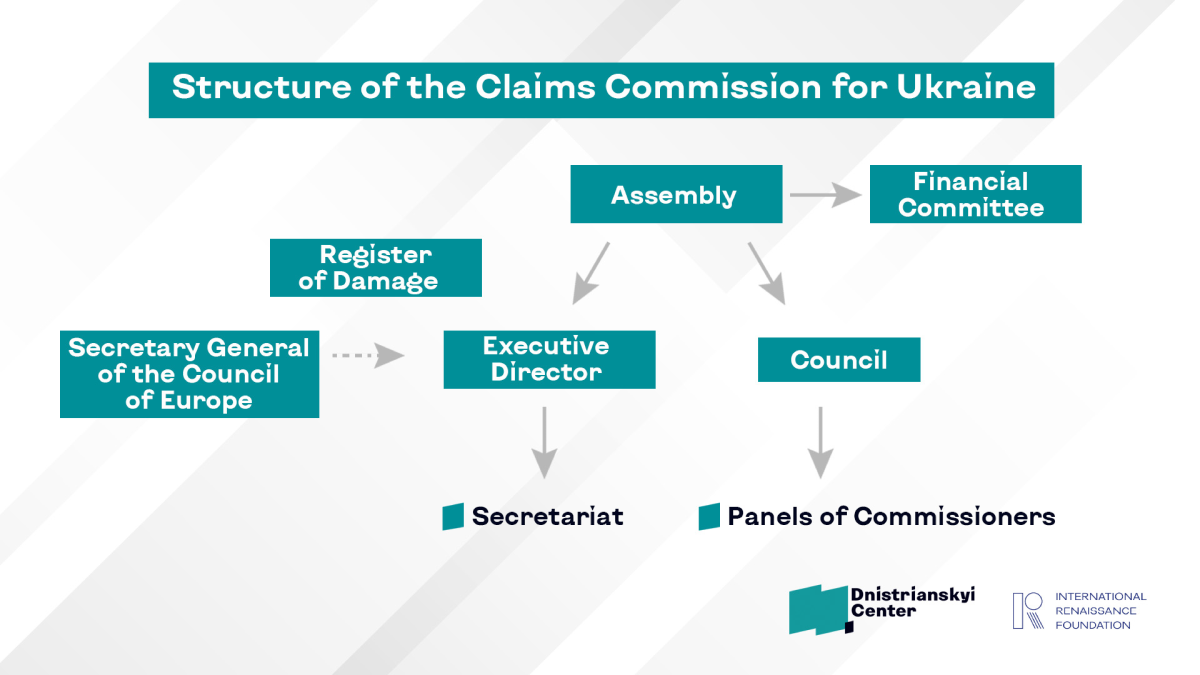
According to Section IV of the Draft Convention, the Commission will consist of an Assembly of States Parties, a Finance Committee, a Council, a Secretariat headed by an Executive Director, and Panels of Commissioners.
Article 7 provides that the Assembly will be composed of all States Parties, which shall elect a President and two Vice-Presidents for a three-year term. The Assembly is expected to meet at least once a year, or more frequently upon its own decision, at the request of the Council of the Commission, at the request of one third of the States Parties, or by decision of the President of the Assembly. The first meeting will be convened by the depositary of the Convention, designated as the Secretary General of the Council of Europe (Article 29).
The key functions and powers of the Assembly, as set out in Article 7(4), can be grouped into three categories:
- Organizational: overall responsibility for implementing the Commission’s mandate; supervision of the activities of its bodies; approval of key documents (rules of procedure, reports, etc.); and establishment of subsidiary bodies.
- Personnel-related: election of members of the Council and the Executive Director; approval of candidate lists; granting consent to the Council’s appointment of Commissioners; and establishment of Panels of Commissioners.
- Financial: setting annual contributions of States Parties; approval of the annual budget, financial reports, and related financial documents.
Under Article 9, decisions on matters of substance require a two-thirds majority of the Assembly. Exceptions include decisions on integrating the Register of Damages into the Commission and on appointing Commissioners and establishing Panels of Commissioners - in which cases an additional requirement applies: approval by all “Major Contributors.” Procedural matters are decided by simple majority.
The Assembly is also empowered to establish advisory committees to address specific tasks within its competence.
One such subsidiary body, established under Article 8, is the Finance Committee. It will consist of representatives of States that are principal donors, of States Parties making comparable financial contributions, and of such other States as the Assembly may designate. The Committee will determine annual assessed contributions, approve contributions from other entities, make recommendations on the draft budget, and perform any additional financial tasks assigned by the Assembly.
As defined in Article 10 of the Draft Convention, the Council will act as the principal executive organ of the Commission. It will comprise between nine and fifteen members, with the exact number determined by the Assembly. Unlike the structure of the Register of Damages, the Draft Convention does not guarantee Ukraine a seat on the Council.
A possible rationale for this difference is that, in the case of the Register, a mandatory Ukrainian representative was essential to ensure the effective collection of evidence in cooperation with the injured State. For the Commission, however, ensuring the impartiality of its activities may be deemed paramount, hence the absence of a guaranteed Ukrainian seat. Nevertheless, in practice, the Assembly may develop a consistent practice of electing a candidate nominated by the Government of Ukraine.
The Council’s powers include appointing and removing Commissioners and forming Panels; developing and adopting procedural instruments (regulations, procedures, methodologies, rules, etc.); and approving, or returning for further consideration, panel recommendations regarding the amount of compensation and their legal or factual basis.
As with the Assembly, substantive decisions require a two-thirds majority, while procedural decisions require only a simple majority. The Draft Convention nonetheless encourages consensus as the preferred method of decision-making.
Claims will be examined by Commissioners, working within Panels composed of three experts. The Draft Convention does not set strict criteria for appointing Commissioners. Article 11 outlines only broad personal and professional requirements: independence, impartiality, integrity, high moral character, relevant experience, multidisciplinary expertise, and balanced geographical and gender representation. Areas of expertise may include international law, dispute settlement, finance, accounting, insurance, or damage assessment.
Candidates for Commissioner positions may be nominated by States Parties or may apply individually. In all cases, they must act in their personal capacity and must not accept instructions from any authority.
The Secretariat will compile an annual list of candidates and submit it to the Assembly for review and approval.
Of particular note is Article 11(4), which provides that “Candidates cannot be disqualified solely on the basis of their nationality.” A literal reading of this clause implies the theoretical possibility that citizens of the Russian Federation could serve as Commissioners - an issue that may require further clarification. The moral and ethical validity of such an approach is more than questionable.
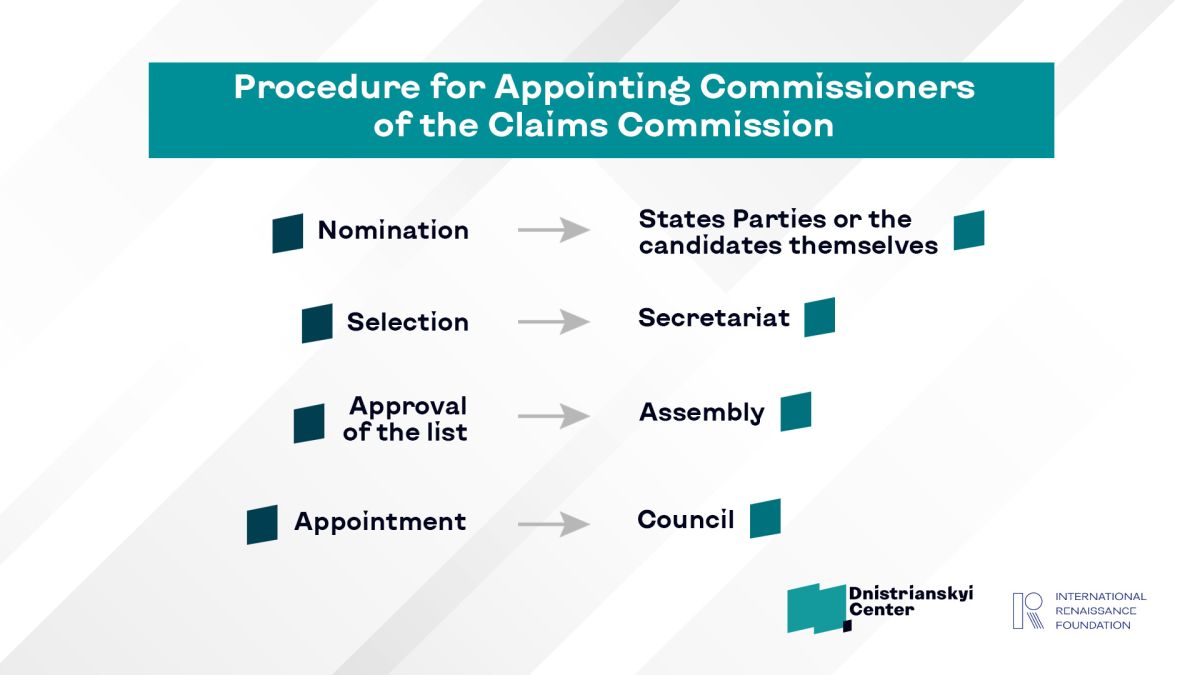
The Draft Convention does not specify the exact number of Panels. Under Article 12, this decision will be taken by the Council, acting on the recommendations of the Secretariat and taking into account “considerations of efficiency, flexibility and workload.” Each Panel will be headed by a Chair, elected by consensus or, if consensus cannot be reached, appointed by the Council.
It is anticipated that different Panels will operate under different mandates, which may imply a division by categories of claims. After reviewing the applications assigned to them, the Panels will issue recommendations on decisions, which will subsequently be submitted to the Council for approval.
According to Article 13 of the Draft Convention, administrative and technical support for the Commission will be provided by the Secretariat, headed by the Executive Director. The Secretariat is expected to be subject to the general staff regulations of the Council of Europe, with one important exception: Article 13(3) introduces requirements for expertise in relevant national law and languages. This provision is clearly intended to enable broader involvement of Ukrainian experts in the Secretariat’s work and to ensure that the Commission as a whole possesses an adequate understanding of the Ukrainian context.
Under Article 14, the Executive Director is elected by the Assembly and appointed by the Secretary General of the Council of Europe for a four-year term. The Executive Director will not only lead the Secretariat but will also represent the Commission and be authorized to act on its behalf.
The core functions of the Executive Director include overseeing the Secretariat’s day-to-day operations; coordinating cooperation within the Commission’s internal organizational framework; managing the assignment of claims to the Panels and the submission of Panel recommendations to the Council; and liaising with relevant national and international institutions regarding the Commission’s activities. The Secretary General of the Council of Europe may assign additional responsibilities as needed.
As with Commissioners, the criteria for selecting the Executive Director are formulated in broad terms, focusing on integrity, high moral character, relevant experience, and professional qualifications. States nominating candidates are also instructed to take into account “the nature of the claims which the Commission is examining.”
With respect to the Register of Damages, Article 24 of the Draft Convention provides that its functions will be transferred to the Commission as soon as possible after the Commission is established and the Executive Director is appointed. Article 25 further stipulates that, once integrated into the Commission, the Register will continue receiving and processing claims submitted by victims. However, the extent of its internal autonomy within the Commission remains unclear.
Procedural and Organizational Aspects of the Commission’s Activities
The primary consideration of claims will take place at the level of the Panels of Commissioners. Under Article 16 of the Draft Convention, the Panels will assess the merits of claims, determine the amount of compensation, and formulate recommendations to the Council of the Commission regarding whether the claims should be approved or rejected. According to Article 17, recommendations of the Panels are expected to be adopted by consensus, or, failing consensus, by a majority vote.
Article 18 provides that the recommendations of the Panels must be approved by the Council of the Commission and, once approved, will be final and not subject to appeal. If the Council declines to approve a recommendation, it must return the recommendation to the Panel with its observations. The Panel must then reconsider the matter and issue a new recommendation taking those observations into account.
The Draft Convention also establishes a special procedure for certain categories of claims, to be specified in the Commission’s Rules and Regulations. In such cases, claims will be considered by an ad hoc Panel composed of the Chairs of the three permanent Panels.
Article 19 of the Draft Convention addresses the use of jurisprudence. It provides that the Panels shall take into accountthe practice of international courts and tribunals, whereas they may take into account the practice of national courts. This formulation reflects established practice within international institutions, where decisions of international courts serve as authoritative precedents, whereas national judicial decisions may provide supplementary guidance but are not binding.
This approach also resolves debates about whether national court judgments must be considered within an international compensation mechanism, while leaving open the possibility of using them as additional sources of reasoning. The same logic is reflected in Article 23(3), which states that decisions of the Commission cannot, as a general rule, be enforced through national judicial mechanisms unless such enforcement is recognized and permitted by the domestic legislation of a State Party.
Under Article 5 of the Draft Convention, the Commission will be headquartered in the territory of one of the States Parties and will maintain a representative office in Kyiv. Additional offices may be established in other States with the consent of the Assembly. This structure largely mirrors that of the Register of Damages, which is headquartered in The Hague with an office in Kyiv.
However, there is an important distinction: whereas the seat of the Register of Damages was determined through an intergovernmental agreement between Ukraine and the Netherlands, the seat of the Commission will be determined by an agreement between the Commission itself - as a separate subject of international law - and the State Party that hosts it.
Given the current location of the Register of Damages and The Hague’s established role as the “capital of international law,” it is reasonable to assume that The Hague may also become the seat of the Commission.
Membership in the Commission
.jpg)
Article 27 of the Draft Convention provides for two modalities of participation in the Commission: full membership and observer status. Observers will not have voting rights or the right to participate in discussions. They are also not required to contribute financially to the Commission’s budget. However, if an observer chooses to make financial contributions, it will be entitled to participate in discussions on financial matters - for example, during the adoption of the annual budget or the approval of financial reports.
Both States and Regional Integration Organizations may become members or observers of the Commission. The Draft Convention explicitly notes the possibility of membership for the European Union.
Initial membership - meaning participation before the Convention enters into force - may be granted to member States of the Council of Europe, the European Union, and States that supported UN General Assembly Resolution ES-11/5 of 14 November 2022. Other States may join at a later stage. This approach is likely designed to ensure consensus during the foundational period of the Commission, reducing the risk that the involvement of States with conflicting positions might obstruct its establishment or operation.
Article 28 separately addresses the possibility of membership for the Russian Federation. According to this provision and other parts of the Draft Convention, such membership would be possible only if several cumulative conditions are met:
- Russia formally acknowledges, through an official declaration, its responsibility for all damage caused by its aggression within the Commission’s mandate;
- Russia agrees to pay reparations for the damage caused;
- Russia undertakes to cover all expenses related to the activities of the Commission;
- Russia accepts special membership rules to be developed by the Commission and approved by the Assembly.
Furthermore, Article 29(2) provides that if Russia later denounces the Convention, the Convention’s provisions will remain binding upon it for ten years following denunciation.
The potential membership of Russia may elicit objections from a moral standpoint. Nevertheless, several considerations weigh in favor of leaving this option open.
First, past practice shows that the participation of the responsible State in international compensation mechanisms is common. Most notably, Iraq participated in the work of the UN Compensation Commission (UNCC).
Second, Iraq’s participation in the UNCC significantly increased the mechanism’s effectiveness and created the practical conditions for the payment of reparations. While Russia is unlikely to take a similar step in the medium term, keeping the possibility open preserves an eventual pathway to compliance.
Third, providing for Russia’s potential membership strengthens the legitimacy of the mechanism by pre-empting criticisms of bias or one-sidedness. From the earliest stages of designing an international compensation mechanism, experts from the Dnistrianskyi Center emphasized the importance of creating conditions that would allow for Russia’s eventual participation - even if such participation remains improbable. The very inclusion of this possibility signals the Commission’s adherence to the principles of international law.
Entry into Force
According to Article 30 of the Draft Convention, it will enter into force once it has been ratified by at least 25 States whose combined financial contributions amount to at least 50% of the Commission’s total budget.
Article 29 designates the Secretary General of the Council of Europe as the depositary of the Convention.
Although Article 34 prohibits States from making reservations upon ratification, Article 33 provides that the Assembly will have the authority to amend the text of the Convention.
The Convention has no fixed expiry date. However, Article 36 stipulates that its provisions will remain in force for at least ten years following its entry into force. This period may be extended for additional five-year terms, provided that two thirds of the States Parties approve the extension at least one year prior to the expiration of the previous period.
The Convention may be terminated in two circumstances:
- if the number of States Parties falls below 25; or
- if there are insufficient funds to finance the Commission’s activities for the coming twelve months.
What Comes Next
The approval of the Draft Convention represents not merely another step, but a substantial advancement toward the establishment of an international compensation mechanism. It reaffirms the consistency of the international community’s efforts to hold Russia accountable for its aggression, particularly through compensation for the damage inflicted.
It is equally important that Ukraine remains committed to the established vision of a comprehensive compensation mechanism, consisting of the Register of Damages, the Compensation Commission, and the future Compensation Fund. This tripartite model draws on previous international legal experience, incorporating both the successes and shortcomings of the UN Compensation Commission and the Eritrea–Ethiopia Claims Commission.
An analysis of the Draft Convention demonstrates that the provisions of greatest importance to Ukraine have either been secured or the conditions for their future implementation have been created. Although certain elements - discussed below - may raise concerns, their inclusion or omission is not the result of shortcomings on the part of the Ukrainian representatives involved in the negotiations, but rather reflects the compromises inherent in any diplomatic process.
One of the key achievements of the Draft Convention is the recognition of the possibility of extending liability to Russia for damage caused in the period 2014–2022, rather than only for the period after 24 February 2022 as currently envisaged. This marks significant progress in addressing an issue that has remained unresolved since the establishment of the Register of Damages in May 2022.
Also notable is the continued recognition of the “presumption of responsibility” of Russia and its obligation to compensate for the damage caused. Moreover, the Convention effectively puts an end to debates regarding the mandatory consideration of national judicial decisions by the Commission.
At the same time, the most challenging aspect of the Draft Convention concerns the financing of compensation. The wording of Article 21 - which states that Russia shall fund the payment of compensation - does not address the potential use of confiscated Russian sovereign assets, assets of individuals involved in the aggression, or other alternative sources of funding.
The decision to leave open the possibility of Russia’s participation in the Commission’s work is understandable: international practice demonstrates that the most effective compensation mechanisms have been those in which the responsible State voluntarily participated. However, given the low likelihood that Russia will acknowledge its responsibility in the foreseeable future, it would be advisable to provide more flexible mechanisms for financing reparations at its expense.
It is likely that these issues will be clarified during the establishment of the Compensation Fund.
The approval of the Convention - expected to be signed at the Diplomatic Conference in December 2025 - is a crucial step toward achieving justice for Ukraine. However, it marks only the beginning of a new, lengthy stage in the development of the Commission’s activities. Its success will depend on three key factors:
- The speed of entry into force, i.e., ratification by at least 25 States, the establishment of the Commission’s institutional structure, and the commencement of the examination of claims and issuance of decisions;
- The Commission’s global reach, achieved by involving States from different regions and legal traditions;
- The ability to secure financing for compensation - either through Russia’s voluntary compliance or through the confiscation of its assets.
The last factor is the most decisive, because, as the initiators of the international compensation mechanism rightly noted in the position paper, “no international claims commission can be considered entirely successful without appropriate funding for paying awards”.
This material was prepared with the support of the International Renaissance Foundation as part of the project "#Compensation4UA / Compensation for War Damages to Ukraine. Phase V: Interim Reparations for Victims of Russian Aggression against Ukraine – Exploring Approaches, Needs and Solutions."