September 25, 2025
Reparations for Ukraine and the negotiation process between Ukraine and Russia
By Ivan Horodyskyy and Dmytro Sherengovsky
The new stage of negotiation process between Ukraine and Russia, which began in May 2025, remains far from producing either a ceasefire or a comprehensive peace treaty. At this stage, the Russian Federation is undermining the very idea of a settlement by combining media leaks of classified documents, ultimatums, and parallel negotiations with the United States without Ukraine’s participation—actions that directly contradict the principles of good faith in international diplomacy.
At the same time, discussions among the various parties involved—Ukraine, Russia, the EU, and the United States—make it possible to record their positions on key issues. One of the most significant of these is compensation for the losses caused by Russian aggression against Ukraine, as well as the potential confiscation of Russian assets.
Documenting these positions provides an opportunity to assess how the different stakeholders currently envision this issue within the broader negotiation process.
Ukraine's Position
For Ukraine, any end to Russian aggression is inevetably linked to compensation for damages and the confiscation of frozen Russian assets to finance reparations. President Volodymyr Zelensky’s "Peace Formula" explicitly states:
"Russia must bear the legal consequences of all its internationally wrongful acts, including compensation for damage, including any damage caused by such acts."
However, the shift in the international context following the election of U.S. President Donald Trump has influenced adjustments to Ukraine’s position.
During the second round of negotiations between Ukrainian and Russian delegations in Istanbul in July 2025, both sides’ "memoranda" were leaked to the media, outlining their initial negotiating positions on key issues.
Ukraine’s proposals, as reflected in the published "memorandum," appear considerably more realistic and pragmatic—particularly on the matter of compensation. Kyiv suggested that frozen Russian assets “be used for the restoration of Ukraine or remain blocked until reparations are paid.”
This approach tactically pursues two objectives: first, to underscore Russia’s unwillingness to engage in serious discussion of compensation; and second, to support the EU and G7 position that “Russia’s sovereign assets will remain blocked until it compensates for the damage caused to Ukraine.”
In doing so, Ukraine emphasizes the principle of irreversibility of sanctions pressure while grounding its claims in international law and UN resolutions that affirm an aggressor state’s obligation to compensate for damages.
Politically, this formulation reflects Ukraine’s recognition that, at the current stage, Russia is unlikely to engage in substantive talks on reparations or other aspects of a political settlement. Ukrainian diplomacy, therefore, appears focused on highlighting Russia’s refusal to accept responsibility while encouraging allies to advance discussions on the confiscation of Russian Central Bank reserves.
Russia’s Position
Russia’s position at the Istanbul talks is predictably ultimatum-like: a demand for a mutual waiver of claims for damages caused during the fighting. This formulation, combined with a call for the unconditional lifting of sanctions, effectively removes the issue of reparations and frozen assets from the agenda and envisages their return to Russia.
Although the insincerity of Russia’s approach is evident, this uncompromising stance leaves little doubt that it reflects the Kremlin’s true vision for resolving the issues of reparations and the frozen assets of the Russian Central Bank.
At the earlier round of Istanbul negotiations in 2022, Moscow advanced a similar model, which envisaged the reciprocal lifting of bilateral sanctions and restrictions, the withdrawal of international court and arbitration claims along with a moratorium on filing new ones, and the creation of a commission to settle mutual property claims at both the state and individual levels (Articles 6–7 of the draft “Istanbul Accords” of 2022).
For Ukraine, whose direct losses from Russian aggression are estimated at hundreds of billions of dollars, such a proposal is economically unviable and politically unacceptable.
Reports also circulated that during U.S.-Russia bilateral talks in Riyadh in February 2025, Moscow proposed unblocking approximately $6 billion of its frozen sovereign assets, with part of the funds allocated to the reconstruction of territories that would remain under Russian occupation after a ceasefire.
For Ukraine, this proposal is equally unacceptable, as it implies shared responsibility for the consequences of Russian aggression.
Given the tactics of Russia’s negotiating team, particularly Kirill Dmitriev, Putin’s special representative for international economic cooperation, it is plausible that Moscow will continue advancing similar proposals, including schemes involving the transfer of frozen assets to a “joint” Russian-American investment fund.
This line of thinking has also been publicly supported by Alexander Shokhin, head of the Russian Union of Industrialists and Entrepreneurs, who argued: “We need to work ahead and prevent the Europeans from using our frozen assets; we need to offer them to the Americans as our contribution to joint projects in third countries.”
Such proposals clearly run counter to Ukraine’s interests, and Kyiv must exert maximum diplomatic efforts to prevent their implementation.
EU Position
The European Union is not directly engaged in the negotiation process at this stage. However, its stance on compensation for damages remains decisive, since the bulk of the Russian Central Bank’s reserves—over $200 billion—are frozen within European jurisdictions.
Official Brussels continues to maintain a cautious position, based on two key principles:
- The issue of reparations from Russia should be settled directly between the parties, while the confiscation of Russian sovereign assets is considered an undesirable scenario.
- Until this issue is resolved, the assets will remain blocked.
This position was recently reaffirmed during discussions of possible truce models. On August 30, at an informal meeting of EU foreign ministers in Copenhagen, the EU High Representative for Foreign Affairs and Security Policy, Kaja Kallas, emphasized: “We can't possibly imagine that, if there is ceasefire or a peace deal, that these assets are given back to Russia if they haven't paid for the reparations.”
The EU’s “centrist” stance reflects internal divisions within the Union. While the Baltic states and Poland advocate for immediate and complete confiscation, Germany and France fear the precedent such a step could set for the global financial system.
At the same time, Brussels has been considering intermediate solutions, such as creating a fund to invest frozen assets in riskier instruments to generate profits for Ukraine, or establishing “reparations loans” backed by these assets. These initiatives suggest that neither outright confiscation nor the return of assets to Russia is viewed in Brussels as a realistic option in the medium term.
Another crucial point is that the fate of frozen assets represents one of the very few issues through which the EU can secure a role at the peace negotiation table. To date, Russia has consistently opposed EU participation, portraying it as “non-subject” and overly dependent on the United States. However, the question of how to manage these assets may eventually compel the Kremlin to reconsider this stance.
US Position
During the administration of President Joe Biden, the United States consistently supported an approach similar to that of the European Union regarding frozen Russian assets. This position was repeatedly reaffirmed in White House statements: “These assets will remain blocked until Russia ceases its aggression and pays for the damage it has caused to Ukraine.”
Like the EU, the United States considered asset confiscation a measure of last resort. Even after the adoption of special legislation that allowed for the seizure of Russian assets in the US, no relevant decisions were implemented.
With the advent of Donald Trump, the US administration has generally avoided taking strong positions on Russia or openly supporting Ukraine, particularly on issues of reparations or asset confiscation. While the White House continues to factor the fate of frozen assets into its strategy, it treats them not as a tool to support Ukraine or reconstruction, but rather as leverage to pressure the Kremlin in the negotiation process.
In an interview with Fox Business on August 27, 2025, US Treasury Secretary Scott Bessant stated: “Regarding frozen Russian assets: I think this is part of the negotiations with Putin. So I don’t think we should seize them immediately. This is one of the important levers in the process of difficult negotiations.”
This statement effectively reflects the current US administration’s negative stance on asset seizure, making it unlikely that Washington will support such a decision before the negotiations are concluded.
On September 13, Bloomberg reported that the United States plans to formally appeal to the G7 countries with a proposal to create a legal mechanism for confiscating frozen Russian assets and directing them to support Ukraine’s defense. According to these reports, Washington is discussing with European partners a phased approach to confiscation designed to increase pressure on the Kremlin and push it toward peace negotiations.
The Trump administration’s focus on using assets as leverage to pressure Russia reflects a longstanding American practice of treating frozen assets as a bargaining chip (as in the cases of Iran or North Korea) rather than as a direct source of compensation.
The United States has not made any recent public statements regarding direct compensation to Ukraine or reparations for victims.
Recommendations
Negotiations between Ukraine and Russia remain hostage to a fundamental asymmetry: for Kyiv, reparations and the confiscation of Russian assets are indispensable conditions for peace, while Moscow seeks to exclude these issues entirely. The EU and the US have yet to demonstrate a unified position—their policies oscillate between cautious support for Ukraine and concerns about destabilizing the global financial system.
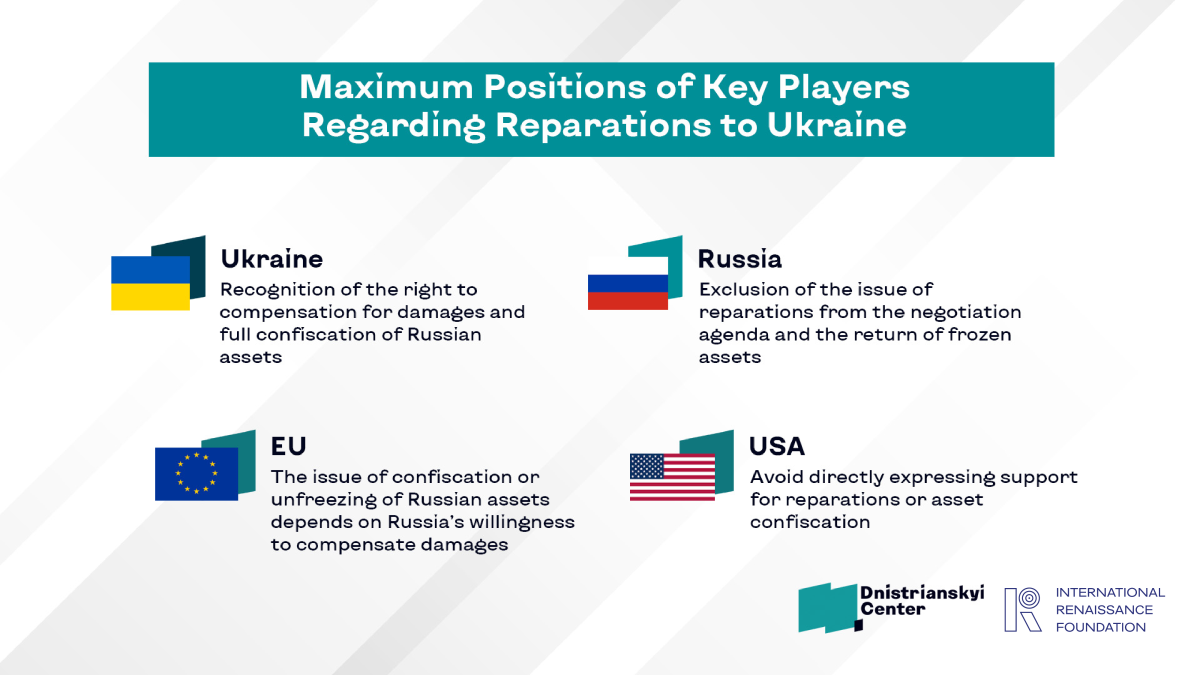
In these circumstances, Ukraine’s key task is to prevent the issue of frozen assets from turning into a “financial frozen conflict” that remains unresolved for years. Ukraine insists on the recognition of its right to compensation and the full, unconditional confiscation of Russian assets. By contrast, Russia demands that reparations be removed from the agenda and that its assets be returned. The EU supports reparations in principle but links the fate of frozen assets directly to Russia’s willingness to pay. The US, under President Donald Trump, avoids direct support for confiscation or reparations in order not to jeopardize ongoing negotiations.
At the same time, all parties have floated “intermediate” options:
- Ukraine: acceptance that assets remain frozen until Russia agrees to reparations—minimizing risks but consolidating the status quo, under which Ukraine receives no real compensation.
- Russia: informal proposals to unlock part of the assets for reconstruction of occupied Ukrainian territories.
- EU: linking assets to compensation talks and exploring new mechanisms for using them in Ukraine’s interests.
- US: treating assets as leverage to pressure Russia into a ceasefire and eventual peace treaty, with the possibility of partial return to Moscow.
Based on this, three main scenarios emerge for Ukraine:
- Positive – Compensation is paid by Russia, or assets are confiscated and used to finance reparations.
- Neutral – Assets remain frozen, generating income but without direct reparations for Ukraine.
- Negative – Reparations are postponed or excluded, and assets are eventually returned to Russia.
Other hybrid scenarios are also conceivable:
- Selective confiscation, where a portion of assets is directed to compensate the most vulnerable categories of victims, creating both precedent and moral pressure for full confiscation.
- Arbitration mechanisms, such as establishing a special international tribunal to decide the fate of assets independently of political negotiations. However, this would likely require Russia’s consent, making it improbable.
To strengthen its position, Ukraine should:
- Firmly insist on the formula: “Russian assets must remain blocked until reparations are paid” as the baseline.
- Consistently employ international legal arguments on the admissibility of asset confiscation and Russia’s duty to provide compensation.
- Press for EU involvement in negotiations on asset use, and in the longer term, for EU recognition as a full party in the political settlement process.
- Explore the creation of a joint Ukrainian–EU–US fund to manage assets after confiscation, thereby ensuring allied unity and preventing asset return.
- Advocate for partial confiscation to compensate victims of Russian aggression, strengthening the moral case for full reparations.
Conclusions
Negotiations between Ukraine and Russia remain constrained by a fundamental asymmetry: for Kyiv, reparations and the confiscation of Russian assets are indispensable conditions for peace, while Moscow seeks to exclude them entirely from the agenda. The EU and the US have yet to articulate a common approach—their policies oscillate between cautious support for Ukraine and concerns over the stability of the global financial system.
In these circumstances, Ukraine’s central task is to prevent the asset issue from turning into a “frozen conflict” in the financial sphere that could remain unresolved for years.
Looking forward, reparations and asset confiscation should not be treated as an isolated track but rather integrated into the broader architecture of Ukraine’s future security guarantees. Alongside military components—such as air and missile defense, port protection, the development of arms production, and integration into collective defense mechanisms—it is essential to establish robust financial and legal response mechanisms that go beyond sanctions. Only such a comprehensive framework, combining military deterrence with automatic financial accountability of the aggressor, can reduce incentives for renewed escalation.
At present, however, Western discussions largely separate security guarantees from sanctions and reparations—an approach that risks strategic failure. Effective guarantees must combine both dimensions: military deterrence and unavoidable economic responsibility.
Ukraine should therefore insist that security guarantees extend beyond joint weapons production or political declarations. They must include a clear condition that any ceasefire or peace agreement will automatically trigger mechanisms for the full or partial confiscation of Russian assets, or at minimum their use for Ukraine’s reconstruction. Such provisions would make guarantees substantive rather than symbolic.
The immediate priority for Ukrainian diplomacy is to ensure that the issue of frozen assets does not become a bargaining chip in potential “grand bargains” between Russia and the West. Instead of relying on defensive tactics that merely preserve the status quo, Ukraine should pursue an offensive strategy: build coalitions within the EU and the US, advance proposals for selective confiscation, and press for the completion of an international compensation mechanism. Only then can reparations become not a postponed compromise, but a real instrument of pressure on Russia and a pathway to justice.
Finally, Ukraine must be prepared for the possibility that Russia, in its characteristic cynicism, will attempt to link the issue of frozen assets to other critical matters—such as the de-occupation of territories, security guarantees, or the release of prisoners of war, deported children, and hostages. In such a scenario, the moral and political dilemmas will be exceptionally difficult, requiring unity, strategic clarity, and resilience.
And most importantly, we should be prepared that, given Russia's cynicism, the issue of assets may at some stage be linked to other key issues: the de-occupation of territories, "security guarantees," the release of prisoners of war, Ukrainian children, and hostages.
The moral decision in this case may be extremely difficult.
The material was prepared with the support of the International Renaissance Foundation as part of the project “Compensation4UA / Compensation for War Damages to Ukraine. Phase V: Interim Reparations for Victims of Russian Aggression against Ukraine – Exploring Approaches, Needs and Solutions".