April 24, 2025
Enforcement of Court Decisions on Claims Against Russia: Proposals for Solving the Problem
Ukrainian courts began considering cases concerning compensation for damages caused by the armed conflict almost immediately after the start of Russian aggression in 2014. However, prior to the full-scale invasion, courts predominantly rejected such claims.
The situation changed after February 24, 2022, following two rulings of the Civil Court of Cassation of the Supreme Court (CCS SC) dated April 14 and May 18, 2022. These rulings recognized the possibility of departing from the principle of sovereign (jurisdictional) immunity in cases involving an aggressor state. Since then, judicial practice has undergone a fundamental shift: in the vast majority of cases, claims have been upheld in favor of both individuals and legal entities (businesses), with compensation amounts in some instances reaching hundreds of millions of Ukrainian hryvnias [the exchange rate as of April, 2025 $1/41 UAH].
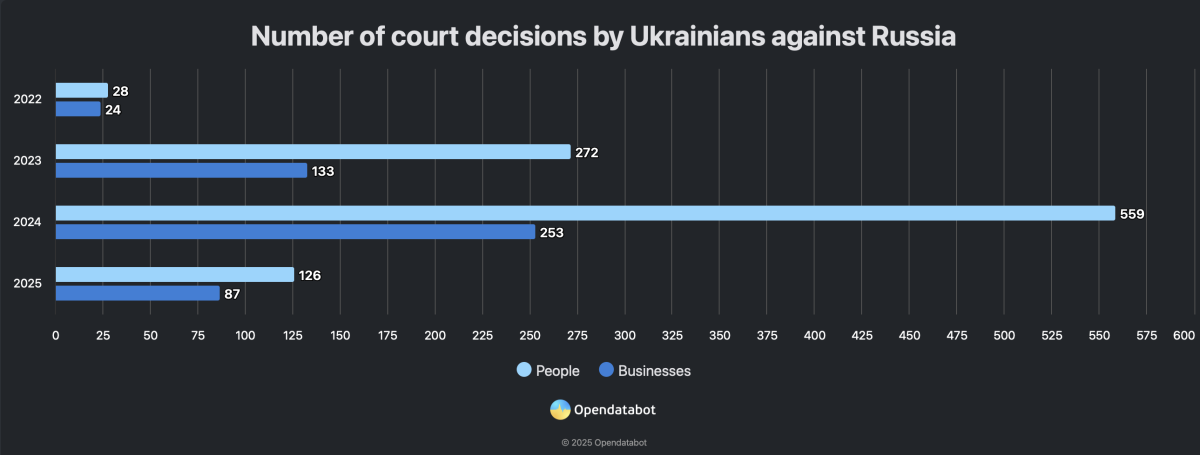
According to Opendatabot, as of April 2025, Ukrainian courts have issued 1,482 decisions in cases concerning compensation for damages caused by armed aggression—and this number continues to grow. While only 52 such decisions were issued in 2022, the first few months of 2025 alone have already seen 213 decisions. In 93% of cases, the courts fully or partially upheld the claims. The largest amount of compensation awarded to an individual is UAH 328 million, while the highest amount awarded to a business stands at UAH 180 billion.
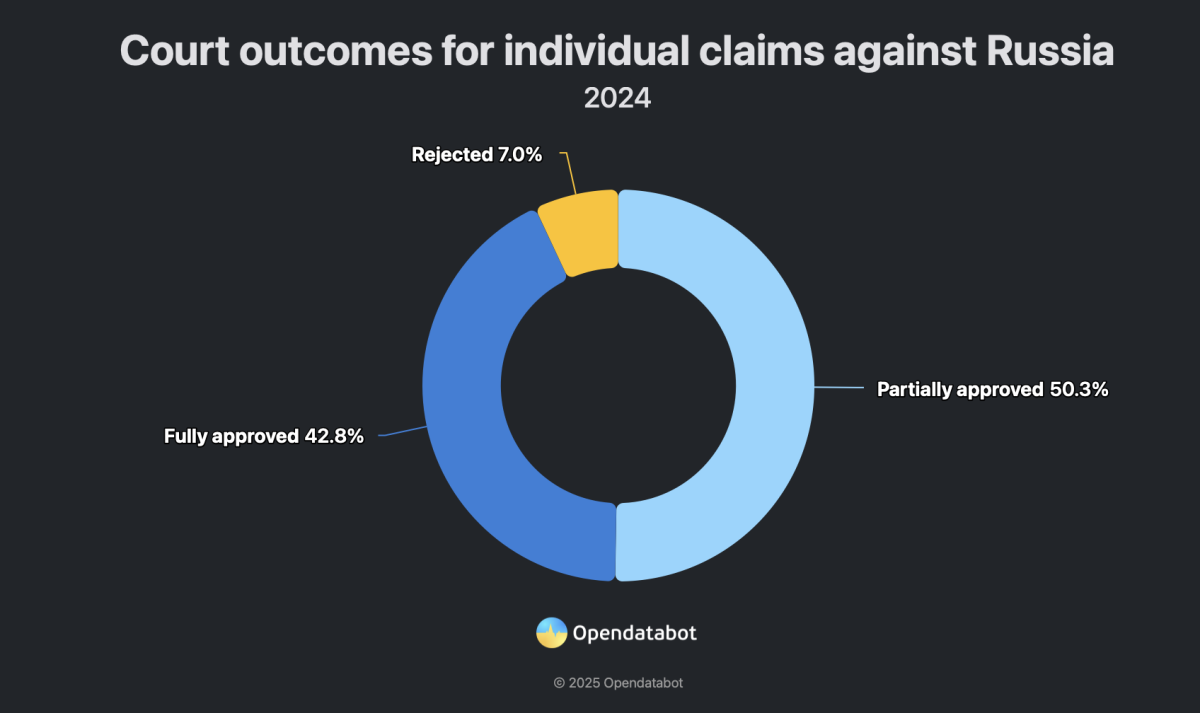
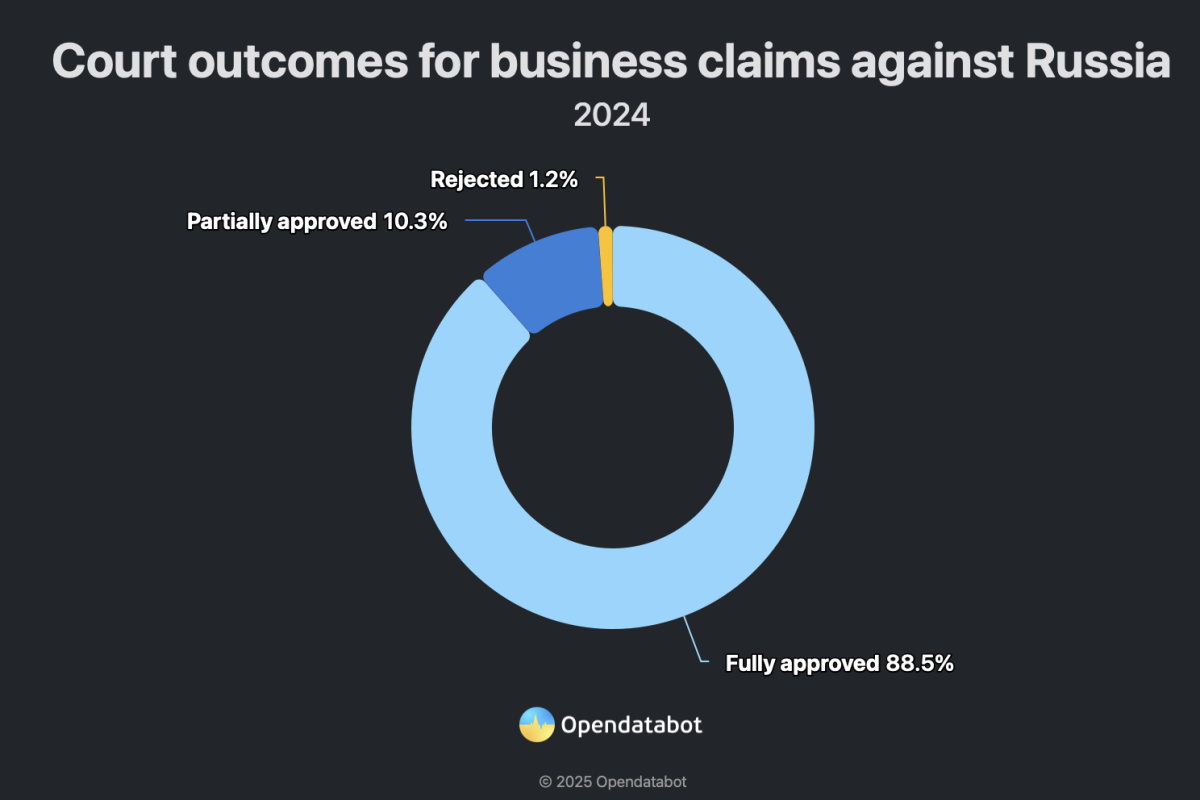
Despite the clear moral and emotional motivations behind court decisions on compensation – namely, the desire to punish the aggressor and ensure justice for the victims – a situation has emerged that, as noted in several studies, risks turning this judicial practice into a problem for the victims, society, and the state itself, due to the practical impossibility of enforcing these decisions.
At the same time, responsibility for this situation should not rest solely with the judges. In a context of war, where the plaintiffs are affected citizens and the defendant is the aggressor state, courts are compelled to administer justice without any corresponding changes to substantive or procedural law. As a result, they often issue decisions that are morally justified but, in essence, legally unenforceable.
Challenges to Enforcement of the Decisions
At present, there is no clear mechanism for enforcing these judgments. Russia does not recognize the decisions of Ukrainian courts and will undoubtedly ignore or challenge them. There are no effective legal or political instruments to compel compliance, and this issue is unlikely to feature in any future negotiations toward a political settlement.
Enforcement of judgments within Ukraine is also currently unfeasible, primarily due to the lack of sufficient Russian sovereign assets located on Ukrainian territory. Furthermore, there is still no definitive government vision regarding the fate of Russian assets seized under the national confiscation mechanism.
The prospects for enforcing such judgments abroad – despite arguments by some lawyers and experts – remain extremely limited. Foreign courts typically reject such claims, invoking the doctrine of sovereign (jurisdictional) immunity, which shields state property from the jurisdiction of other states. Even in rare instances where foreign proceedings are initiated, the admissibility of Ukrainian court decisions remains unresolved.
Given the foundational role of sovereign immunity in maintaining stability in international trade and the global financial system, any broad derogation from this principle with respect to Russian assets appears unlikely. A potential exception may be the reserves of the Russian Central Bank, around which an emerging international consensus supports their confiscation as a form of collective countermeasures.
In parallel, Ukraine has strategically committed to establishing an international compensation mechanism – the Register of Damages, the Compensation (Claims) Commission, and the Compensation Fund – as the primary framework for ensuring redress for damage caused by the aggression. Representatives of this mechanism have repeatedly stated that decisions by Ukrainian courts can serve as evidence of damage, but no other formal role for these decisions is currently envisioned.
However, the steadily increasing number of court decisions awarding compensation for damage caused by Russian aggression, as previously noted, presents serious challenges for Ukraine.
First and foremost, the failure to enforce these decisions – or even prolonged delays in enforcement – risks undermining public trust in the government and the judicial system. This risk is particularly acute in the context of post-war reconstruction, which will be a difficult and crisis time, demanding a high degree of social cohesion and confidence in public institutions.
Moreover, the failure to implement these judgments may amount to a serious breach of Ukraine’s international obligations, particularly under Article 6 of the European Convention on Human Rights. In the future, claimants who do not receive the compensation awarded by Ukrainian courts may turn to the European Court of Human Rights, which is likely to rule in their favor. In such cases, it will be Ukraine – not Russia – that is required to pay these sums.
It is important to emphasize that this does not concern compensation for damages caused by Russia – since Ukraine is not responsible for those unlawful acts – but rather satisfaction awarded due to Ukraine’s failure to enforce its own judicial decisions.
Chilean Precedent
Ukraine is unlikely to avoid addressing the issue of (non-)enforcement of these decisions. International practice demonstrates that in such situations, a government cannot simply disregard the validity of court decisions or unilaterally declare them null and void.
A relevant example is Chile’s experience following the end of Augusto Pinochet’s regime. In the aftermath, administrative mechanisms were introduced to compensate victims of the dictatorship. The Chilean government, through its representatives, argued that victims were not entitled to pursue court-ordered compensation, citing the relatively short statute of limitations under the Civil Code and the fact that compensation had already been provided through administrative instruments.
However, in late 2014, the Chilean Supreme Court, sitting in plenary session, decided to reassign these cases from the civil panel to the criminal panel. This move effectively set aside the statute of limitations argument and created a legal pathway for awarding compensation through the courts, even in cases where victims had already received administrative reparations. This approach was confirmed by a landmark decision on April 28, 2015, in the case of Rol 23441-2014, filed by Bernardo Meza Rubilar.
Ultimately, the Chilean government was compelled to acknowledge the legitimacy and necessity of enforcing these judicial decisions. This position was publicly affirmed by Chilean then-Minister of Justice Luis Cordero in August 2024.
Recommendations and Conclusions
At present, there are unfortunately no visible signs of dialogue between the Ukrainian judiciary and the executive branch on how to address the issue of (non-)enforcement of such judgments. However, this issue cannot be ignored and demands an immediate, coordinated, and strategic response.
To effectively resolve this problem, the Ukrainian government should initiate the development of a comprehensive and coordinated approach—one that balances the legitimate interests of victims with the broader interests of society and aligns with the principles and logic of the emerging international compensation mechanism.
The following key elements are proposed as part of such a solution:
- Introduce an Alternative Compensation Mechanism for Victims. Victims who have obtained court decisions awarding compensation for losses inflicted by the Russian aggression should be offered an alternative remedy. Specifically, the state could provide a fixed, lump-sum payment approximating the amount of satisfaction likely to be awarded by the European Court of Human Rights for failure to enforce a domestic judgment.
In exchange, claimants would agree to transfer to the state their right to claim against the Russian Federation, under the “assignment of claim” formula initially proposed at the start of the full-scale aggression. Should a larger amount later be recovered through an international compensation mechanism, victims would retain the right to receive the difference.
Eligibility for this mechanism would be limited to those who obtained court decisions on compensation prior to the effective date of the relevant legislative amendments or any other date set by law.
Funding for these payments could be sourced from assets confiscated by the High Anti-Corruption Court under Ukraine’s national confiscation mechanism.
Importantly, those who decline this offer would retain the right to pursue enforcement independently or to file a complaint against Ukraine before the ECtHR for failure to enforce a final domestic judgment.
2. Amend Substantive and Procedural Legislation
Amendments should be introduced to both substantive and procedural law to comprehensively regulate the enforcement of court decisions awarding compensation for damage caused by the armed aggression of the Russian Federation, where the defendant is the aggressor state or its entities. These amendments should help establish a stable and predictable judicial practice on this matter.
3. Seek a Resolution from the Grand Chamber of the Supreme Court
The Grand Chamber of the Supreme Court should be called upon to issue a resolution on the issue of derogation from sovereign (jurisdictional) immunities. The current legal position – based on the ССС SC rulings – is still evolving and often cited without critical engagement by lower courts. A resolution from the Grand Chamber would provide authoritative guidance, clarify the legal framework, and contribute to the development of a consistent and coherent judicial approach.
The need for such a resolution has already been emphasized by the CCC SC itself in 2020.
4. Establish Institutional Dialogue and Conduct a Public Information Campaign
An institutional dialogue must be initiated between the executive and judicial branches to address the implementation of compensation judgments. This dialogue should focus on refining judicial practice and preparing necessary legislative amendments.
In parallel, a nationwide information campaign should be launched – targeted both at the general public and affected individuals – to explain the nature, rationale, and benefits of the proposed compensation mechanism.
A key argument should be that the cost, time, and uncertainty involved in attempting to enforce judgments may exceed the value of the compensation offered by the state, which in many cases may represent the most realistic and efficient remedy.
Conclusion
The primary objective of the proposed mechanism is to protect the rights and interests of victims to the greatest extent possible under current circumstances, while also preserving public trust in Ukraine’s judiciary and executive institutions. Moreover, this approach would enable Ukraine to consolidate and assert its claims within the future international compensation framework, at least in cases where assigned claims are deemed admissible.
Although the proposed solution is not optimal – ideal solutions would have required earlier implementation during the initial phase of the aggression and judicial response – it represents a realistic and necessary compromise.
Failure to address the enforcement issue, or to provide an adequate and timely response, risks far more serious consequences in the future - both in terms of the rights of victims and Ukraine’s international reputation and internal social cohesion.
The material was prepared with the support of the International Renaissance Foun-
dation as part of the project “#Compensation4UA/Compensation for war losses for
Ukraine. Phase IV: Addressing Specific Issues to Ensure Compensation.