March 14, 2025
F-16 fighters, Leopard tanks and the "Danish model" of defense investment: how Denmark supports Ukraine
by Dariia Cherniavska
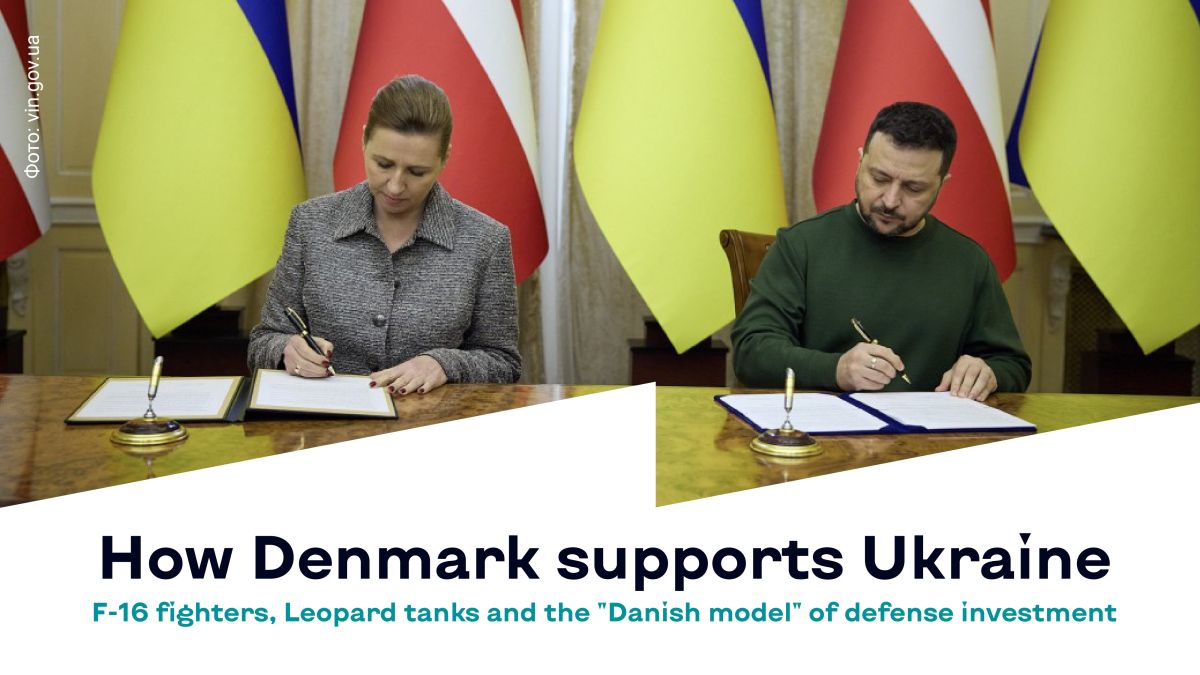
On February 23, 2024, Ukraine signed a bilateral security agreement with Denmark - the Agreement on Security Cooperation and Long-Term Support between Ukraine and Denmark.
This agreement was the first security agreement concluded with a country outside the Group of Seven (G7) as part of the formalization of the Joint Declaration of Support for Ukraine, which was signed on July 12, 2023. Previously, Ukraine has signed similar security agreements with three G7 countries - the United Kingdom, Germany, and France.
As of February 23, 2025, Ukraine has signed a total of 29 bilateral cooperation agreements, including 27 agreements with the signatories to the Joint Declaration, 1 agreement with the EU, and 1 agreement with Croatia, which has not joined the Joint Declaration.
All security agreements within this series are signed for 10 years and contain mostly similar provisions on comprehensive support of Ukraine by partner states. In particular, they include the provision of weapons and military equipment to Ukraine for self-defense in the war with Russia, cooperation in the defense industry, training for the Ukrainian military on the territory of partner states, humanitarian support, strengthening cybersecurity, restoring energy infrastructure, increasing sanctions pressure on Russia and bringing the aggressor to justice.
What commitments has Denmark made under the security agreement
The provisions of the security agreement with Denmark can be summarized in 10 areas of bilateral partnership:
- Provision of arms and military equipment to Ukraine.
- Cooperation in the defense industry.
- Use of frozen Russian assets to support Ukraine.
- Training of the Ukrainian military.
- Sanctions against Russia and its supporters.
- Non-military security and civil protection.
- Demining of Ukrainian territories.
- Support for energy infrastructure.
- Humanitarian and reconstruction support for Ukraine.
- Holding Russia accountable.
The security agreement with Denmark, unlike the vast majority of other agreements with partner states, contains clear provisions and commitments of Denmark regarding military assistance to Ukraine. Denmark pledged to provide at least €1.8 billion in military support to Ukraine through 2024, including through the provision of F-16 fighter jets and ammunition, as well as by strengthening Ukraine's air defense, unmanned aerial vehicle capabilities, and maritime security. The agreement also envisages strengthening Ukraine's defense industry through Danish investments, joint research and production. Additionally, Denmark pledged to participate in the training of Ukrainian military personnel, including UAV operators and F-16 fighter pilots.
The provisions of the agreement are not limited to military support from Denmark, but also include Danish participation in strengthening non-military security and civil defense of Ukraine, with a focus on countering Russian cyber aggression.
The other two pillars of the security agreement are the path to a just peace and humanitarian assistance for Ukraine. The first block includes strengthening sanctions pressure on Russia and its supporters, finding legal ways to use frozen Russian assets to support Ukraine, and holding the Russian Federation accountable for its illegal actions against Ukraine, in particular by establishing a tribunal. The second pillar envisages Denmark's diverse contributions to humanitarian demining of Ukrainian territories, support for the energy sector, and Ukraine's long-term recovery.
Implementation of the agreement: how and to what extent Denmark supported Ukraine over the year
From February 23, 2024, to February 23, 2025, Denmark regularly fulfilled its obligations in all 10 areas of cooperation under the security agreement.
Military support
In 2024, Denmark was able to exceed the military support plan set out in the security agreement. Instead of the announced €1.8 billion, Denmark allocated €2.8 billion for military assistance to Ukraine in 2024. Thus, Denmark has become one of the world's top five countries in terms of military support for Ukraine.
The priority areas of military assistance in the 8 comprehensive defense packages announced from February 23, 2024, to February 23, 2025, were investments in the Ukrainian defense industry and strengthening the capabilities of the Ukrainian Air Force.
As a co-leader of the Air Force Capability Coalition, Denmark, together with the Netherlands, has demonstrated leadership in providing Ukraine with F-16 fighter jets. Since August 2024, Ukraine has received 12 out of a total of 19 announced F-16 fighters from Denmark, which have been modernized under the Mid-Life Update (MLU) program. Denmark will provide another 7 fighters in 2025.
During the year of implementation of the agreement, Denmark was actively involved in the Armored Vehicle Coalition. In the summer, Denmark provided Ukraine with 8 Leopard 1A5 tanks together with Germany and additional 14 Leopard 2A4 tanks together with the Netherlands. And at the end of 2024, Denmark, together with Sweden, handed over a batch of CV90 infantry fighting vehicles to Ukraine and ordered the production of 40 more CV90 infantry fighting vehicles from the defense company BAE Systems Hägglunds.
Other capability coalitions - the Artillery Coalition, the Drone Coalition, the Maritime Capability Coalition and the Air Defense Coalition - have been strengthened through financial contributions and direct participation by Denmark. In particular, Denmark has invested at least €300 million in the procurement of Caesar and 155-mm artillery shells within the Artillery Coalition. In addition, in just 3 months of the Drone Coalition's existence - from February to April 2024 - Denmark, together with the Netherlands, contributed €400 million to the purchase of Ukrainian and foreign-made drones. In order to strengthen Ukraine's maritime capabilities, at the end of April 2024, Denmark, together with Estonia, handed over 2 patrol boats to Ukraine to help patrol and protect Ukrainian maritime waters. And to strengthen Ukraine's air defense, Denmark has allocated more than €325 million for the purchase of air defense missile systems for Ukraine.
Such comprehensive defense support from Denmark should last at least until 2028, as Denmark has committed to provide €2.2 billion in military assistance to Ukraine annually over the period 2025-2028.
Cooperation in the Defense Industry
Denmark demonstrated global leadership in strengthening Ukraine's defense industry in 2024. In particular, Denmark became the first NATO country to invest in the production of weapons for the Ukrainian Defense Forces in Ukraine.
The first step towards this bilateral partnership was the Statement of Intent to purchase Ukrainian arms through the Ukrainian Fund, which Denmark and Ukraine signed on April 27, 2024. In June, this Statement was further documented in the form of a Memorandum on the purchase of arms and military equipment from Ukrainian manufacturers. Subsequently, Denmark launched a pilot project to invest in the Ukrainian defense industry, investing €50 million in the production of 18 Bohdana self-propelled artillery systems, which were delivered to the Armed Forces of Ukraine in September.
After the successful implementation of this project, Denmark and Ukraine signed a Letter of Intent on September 29 to support defense production in Ukraine and officially established the "Danish model" - a program of direct financial contributions to Ukraine's defense industry by Denmark and other countries.
In 2024, Denmark allocated €125 million for the development of the Danish model, including the production of Ukrainian attack UAVs, missiles, self-propelled artillery systems, and anti-tank systems. Another €390 million were allocated to the Danish model from the interest on frozen Russian assets managed by Denmark on behalf of the EU. In total, in 2024, the Danish model managed to attract about €540 million to the Ukrainian defense industry. In addition to Denmark, Sweden with an investment of €20 million and Iceland with an investment of €3 million joined the program.
In 2025, Denmark continues to strengthen the Ukrainian defense industry. For this year, Denmark has reserved €130 million for investment in Ukrainian defense production.
The partnership between Ukraine and Denmark is not limited to direct investment in the Ukrainian defense industry. On February 15, 2025, Ukroboronprom signed a memorandum with Weibel Scientific, a Danish defense company that specializes in the development of radar stations. The partnership envisages the establishment of maintenance and repair services for Weibel's advanced radar solutions in Ukraine, joint development of new technologies, and the creation of a joint venture in Ukraine.
Using frozen Russian assets to support Ukraine
As a member state of the European Union, Denmark has joined EU initiatives to use the proceeds of frozen Russian assets to support Ukraine.
In the late spring of 2024, the EU adopted a number of legal acts to enable the transfer of proceeds from frozen Russian assets to Ukraine, including in the form of military support and reconstruction assistance. A little later, on July 26, the European Commission announced the first tranche of €1.5 billion in proceeds from frozen Russian assets to Ukraine. These funds were used for military assistance, including the purchase of air defense systems and artillery shells, as well as investments in the Ukrainian defense industry.
And in the fall, Ukraine received an additional €390 million in investments in the Ukrainian defense industry through interest on frozen Russian assets under the Danish model, with Denmark managing these frozen assets on behalf of the EU.
At the end of October, the EU approved a decision to provide Ukraine with a loan of up to €35 billion as part of the G7's Extraordinary Revenue Acceleration Loans for Ukraine (ERA) program. This program was initiated by the G7 countries and envisages providing Ukraine with $50 billion in loans from the proceeds of frozen Russian assets, including those of the Central Bank of the Russian Federation.
Already in January 2025, Ukraine received the first tranche of funds from the EU in the amount of €3 billion under the ERA program, which helped cover part of its priority budget expenditures. In total, in 2025, the EU will provide Ukraine with the announced €35 billion under the G7 ERA initiative and the Ukraine Facility program.
Training of the Ukrainian military
In 2024, Denmark was actively involved in the Interflex training program for the Ukrainian military, which was organized by the United Kingdom in 2022. As part of this program, at least 8 teams of instructors from Denmark conducted general military training for Ukrainian servicemen in the UK. In particular, instructors from the Royal Danish Armed Forces Forsvaret played an important role in improving the firearms training skills of the Ukrainian military.
In addition, during the year of implementation of the agreement, Denmark trained at least 20 Ukrainian pilots of F-16 fighter jets and about 100 Ukrainian specialists to maintain these fighters at one of its air bases. This includes the training of two groups of 50 specialists who are to ensure the effective use of F-16 fighters in Ukraine: technicians, mechanics, and ground personnel.
Sanctions against Russia and its supporters
Denmark has joined 3 comprehensive EU sanctions packages announced against Russia during the year of implementation of the security agreement. The restrictive measures mainly targeted the military, important sectors of the Russian economy, the energy sector, as well as individuals and legal entities responsible for war crimes, including the deportation of Ukrainian children.
In particular, under the 2nd sanctions package in 2024 and the 14th EU sanctions package in general, restrictive measures were aimed at banning transshipment of Russian liquefied natural gas (LNG) in the EU for transit to third countries, banning access to ports and services for ships contributing to the war, including 27 ships of the Russian shadow fleet, expanding the ban on flights from Russia to the EU, and increasing restrictions on exports of goods to Russia.
At the same time, the 3rd EU sanctions package in 2024 and the 15th package of sanctions since the beginning of the full-scale invasion in general became the most comprehensive. The sanctions lists include 52 vessels of the Russian shadow fleet, a chemical plant, Russian defense and shipping companies, a civilian Russian airline, individuals responsible for the deportation of Ukrainian children, and the military unit responsible for the shelling of the Okhmatdyt children's hospital in Kyiv.
The EU imposed sanctions not only on Russia but also on its supporters. In particular, restrictive measures have been imposed on officials and legal entities in Iran, China, North Korea, India, Serbia, and the UAE for supplying Russia with drones or missiles, as well as for helping to circumvent sanctions.
In addition to its involvement in comprehensive sanctions packages against Russia, Denmark has also regularly contributed to increasing sanctions pressure on Russia. In the summer of 2024, Denmark initiated negotiations to stop the transportation of sanctioned Russian oil by a shadowy fleet of tankers through the Baltic Sea. And in January 2025, Denmark joined an initiative group of 10 EU member states that signed a joint statement on a complete ban on pipeline and liquefied natural gas imports from Russia to the EU.
Non-military security and civil protection
Strengthening Ukraine's non-military security was one of the priority areas of cooperation between Denmark and Ukraine in 2024.
Denmark has joined two key collective mechanisms to strengthen Ukraine's cybersecurity - the IT Coalition and the Tallinn Mechanism.
The IT Coalition, in which Denmark is one of the 17 member states, has accumulated €482 million in 2024 to support the Ministry of Defense of Ukraine and the Armed Forces in the field of communications, IT and cybersecurity. Another €200 million were allocated by the Tallinn Mechanism member states to strengthen Ukraine's cyber resilience, in particular, Ukraine's ability to counter Russia's malicious cyber operations.
Denmark has joined not only to support Ukraine's cyber capabilities, but also to strengthen civilian protection. Between June and October 2024, the State Emergency Service of Ukraine received 18 rescue lifts worth €17 million from Denmark, which were provided in 4 batches. This support is intended to strengthen the capacity of the State Emergency Service to provide emergency assistance after Russian shelling or other emergencies.
Demining
Throughout 2024, Denmark actively supported humanitarian demining of Ukrainian territories. As part of the collective initiative "Mine Action in Ukraine" organized by the United Nations Development Program (UNDP), Denmark became one of 14 countries whose financial contributions helped clear 35,000 km² of land in Ukraine in 2024.
Additionally, the Danish government, together with the EU, the governments of Japan and Sweden, sent specialized demining and protection equipment to 202 pyrotechnic teams of the SES in the spring of 2024. In total, about 80% of all SES units received specialized equipment, so this assistance has significantly increased the capacity of Ukrainian rescuers.
Denmark contributes to the demining of Ukrainian territories not only through collective initiatives but also through individual efforts. In the spring of 2024, the Ministry of Economy of Ukraine announced that it would deepen cooperation with the Danish company Hydrema, which manufactures mechanical demining machines. Due to the localization of production in Ukraine and joint Ukrainian-Danish production, it was planned to increase the total number of Hydrema machines to 14 by the end of 2024, which would accelerate humanitarian demining in Ukraine.
Energy
Along with military support and investments in the Ukrainian defense industry, the restoration of Ukraine's energy infrastructure is one of the priority areas of assistance from Denmark.
Denmark is a co-chair of the working group on the implementation of the third pillar of the Peace Formula, Energy Security, and Danish support regularly strengthens the Ukrainian energy sector.
In particular, at the end of April, Denmark and Ukraine signed a Memorandum of Understanding on long-term cooperation and reconstruction of Ukraine, under which Denmark allocated €380 million to support critical infrastructure using renewable energy. Additionally, in 2024, Denmark has allocated more than €30 million to restore Ukraine's energy system after massive Russian attacks.
Denmark's long-term intentions to strengthen Ukraine's energy sector were realized at the end of January 2025 with the start of construction of the second phase of the largest wind farm in Eastern Europe. DTEK and Danish company Vestas signed a €450 million agreement to build the second phase of the Tiligul wind farm in Mykolaiv region. In total, Phases I and II of DTEK Tiligul Wind Farm will consist of 83 wind turbines and will reduce CO2 emissions by 1.7 million tons annually.
Humanitarian and reconstruction support for Ukraine
In 2024, Denmark has allocated €314 million for humanitarian support to Ukraine, including €114 million for recovery and reconstruction.
In particular, in April 2024, Denmark allocated an additional $43 million to the Danish Export Investment Fund to develop Ukrainian imports to Denmark and support more than 20 Danish companies that are ready to invest in Ukraine and conduct business in Ukraine.
At the same time, in April, Ukraine and Denmark signed a Memorandum of Understanding on long-term cooperation and reconstruction of Ukraine, under which the Danish government has allocated €40 million to support the private sector involved in the reconstruction of Ukraine. This Memorandum covers, among other things, deepening cooperation between Ukraine and the Danish company Carlsberg Group, which is one of the largest Danish investors and taxpayers in Ukraine, owning three breweries and paying over UAH 3 billion in taxes and fees annually.
The following month, Denmark pledged around €35 million in humanitarian support for Ukraine to provide basic emergency assistance - food, medicine and shelter - to the most affected Ukrainians.
Denmark has also joined targeted projects to provide humanitarian aid to Ukraine. In the spring, Denmark began building 3 family-type eco-houses in Ukraine for the psychological recovery of children deprived of parental care. And in the fall, Denmark, together with the EU and Canada, donated 10 vehicles to Ukraine to provide social and medical services in the most remote frontline communities, in particular in Zaporizhzhia, Mykolaiv, Kherson, and Dnipro regions.
Denmark also helped strengthen Ukraine's European integration capabilities. At the end of January 2025, Denmark, Lithuania, and the EU launched the Ukraine2EU initiative - the Fund for Supporting Ukraine's Integration into the EU. Denmark, together with its partners, has invested €14 million to support Ukrainian institutions on their path to European integration in 2025-2027.
Thus, Danish humanitarian support during the year of implementation of the agreement contributed to the regular strengthening of Ukraine's resilience.
Holding Russia accountable
During the year of implementation of the security agreement, Denmark contributed to holding Russia accountable within two key coalitions - the Coalition for the Establishment of a Special Tribunal for the Crime of Aggression against Ukraine and the International Coalition for the Return of Ukrainian Children.
In the spring of 2024, Denmark joined 43 other countries in signing a joint Declaration at the conference "Restoring Justice for Ukraine", which expressed support for the establishment of a special tribunal to investigate and prosecute the crime of aggression against Ukraine, holding Russia’s highest military and political leadership accountable.
Denmark signed a similar Statement of Commitment to the Prompt Establishment of a Special Tribunal to Prosecute the Top Military and Political Leadership of the Russian Federation in the fall, together with other member countries of the Coalition for the Establishment of a Special Tribunal. And in early February 2025, the Coalition laid the legal groundwork for the establishment of the special tribunal by defining the key provisions of the Schuman Draft Statute, the main legal document of the Tribunal.
Additionally, thanks to the efforts of Denmark and other member countries of the International Coalition for the Return of Ukrainian Children, in 2024 Ukraine managed to return home almost 600 children deported by Russia.