March 1, 2025
How Germany supports Ukraine: IRIS-T air defense, partnership with Rheinmetall, and leadership in the EU
by Dariia Cherniavska
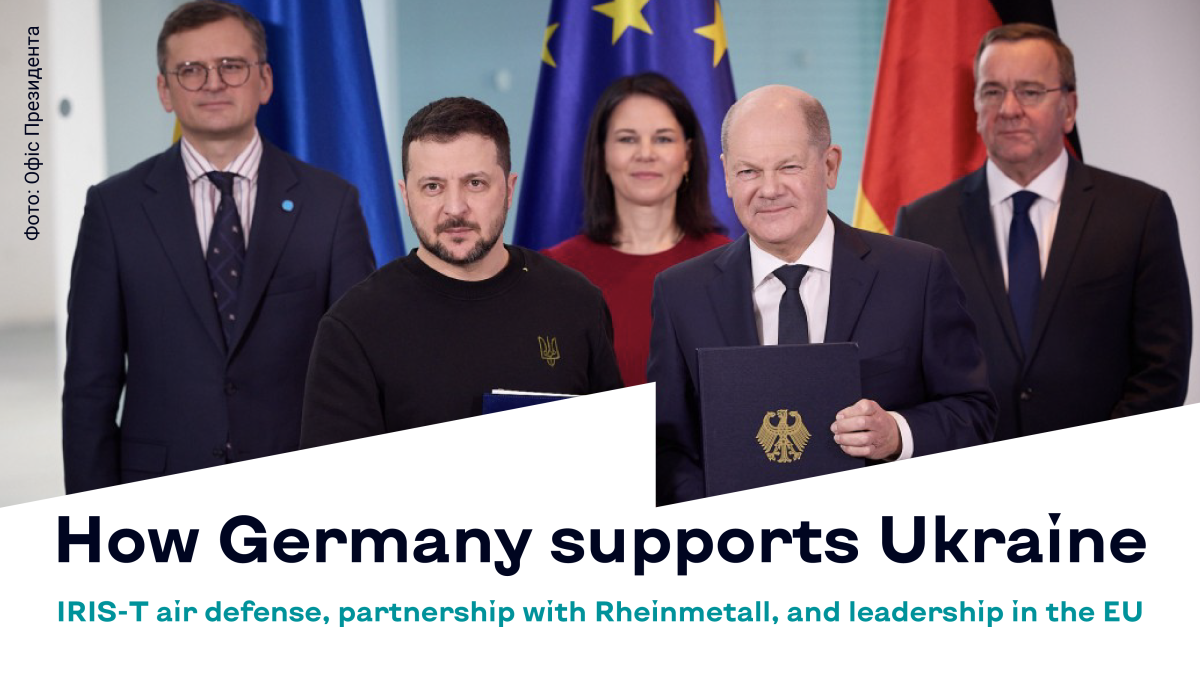
On February 16, 2024, Ukraine signed a bilateral security agreement with Germany – the Agreement on Security Cooperation and Long-Term Support between Ukraine and the Federal Republic of Germany.
This security agreement was the second of 28 bilateral security agreements concluded as part of the formalization of the Joint Declaration on Support for Ukraine, signed on July 12, 2023, by the countries of the Group of Seven (G7). This Joint Declaration was the starting point and framework document that laid the foundation for future security agreements with other countries.
As of February 16, 2025, Ukraine had concluded 29 bilateral cooperation agreements, including 27 agreements with the signatory states of the Joint Declaration, 1 agreement with the EU, and 1 agreement with Croatia, which did not join the Joint Declaration.
All these security agreements are signed for 10 years and contain fairly similar provisions regarding comprehensive support for Ukraine from partner states. In particular, they provide for the supply of weapons and military equipment to Ukraine for self-defense in the war with Russia, cooperation in the defense-industrial complex, training for Ukrainian military personnel on the territory of partner states, humanitarian support, strengthening cybersecurity, restoring energy infrastructure, increasing sanctions pressure on Russia, and bringing the aggressor to justice.
What commitments has Germany made under the signed security agreement?
The security agreement between Ukraine and Germany provides for comprehensive cooperation on 10 points:
- Provision of weapons and military equipment to Ukraine.
- Cooperation in the defense industry.
- Use of frozen Russian assets to support Ukraine.
- Training of Ukrainian military personnel.
- Sanctions against Russia and its supporters.
- Non-military security and civil protection.
- Demining of Ukrainian territories.
- Support for energy infrastructure.
- Humanitarian support and support for the reconstruction of Ukraine.
- Holding Russia accountable.
In the area of military support, the agreement provides for Germany to allocate €7.1 billion for the purchase of weapons for Ukraine during 2024. The priority areas of cooperation are air defense, armored vehicles, and artillery. Partnership in the defense industry, in particular German investments in the Ukrainian defense complex and the localization of German defense production in Ukraine, should further strengthen Ukraine's defense capabilities.
The security agreement includes cooperation in areas other than the military. Germany has committed to providing individual and collective training for Ukrainian military personnel, contributing to the strengthening of civil protection and cybersecurity in Ukraine, and providing humanitarian and reconstruction support. This includes, in particular, financial contributions to humanitarian demining, innovative reconstruction programs, and energy efficiency.
An important area of cooperation under the agreement is increasing the cost of Russian aggression for Russia. First and foremost, the provisions of the agreement provide for Germany to exert sanctions pressure on Russia within the EU, attempts by Germany to use the proceeds from frozen Russian assets to support Ukraine, and joint efforts to bring to justice those responsible for war crimes committed on or against Ukraine.
Implementation of the Agreement: Assistance Provided by Germany Over the Past Year
Over the year of implementation of the bilateral security agreement, Germany has ensured the active and systematic fulfillment of all its obligations under the agreement.
Military support
In 2024, Germany fulfilled the military aid plan announced in the bilateral security agreement. The country's federal government allocated approximately €7.1 billion for military support to Ukraine. Thanks to these investments, Germany became the second country in the world after the US in terms of military aid provided to Ukraine and demonstrated its leadership in the EU.
As the leader of two capability coalitions – the Integrated Air and Missile Defense Coalition and the Armored and Maneuver Coalition – Germany directed a significant portion of these funds toward the purchase of air defense and armored vehicles for Ukraine. In particular, during the year of implementation of the security agreement, Germany provided Ukraine with at least 9 IRIS-T air defense systems – 5 medium-range IRIS-T SLM systems and 4 short-range IRIS-T SLS systems with missiles, 3 Patriot air defense systems, 5 Gepard air defense systems with over 125,000 rounds of ammunition, and 1 Skynex air defense system.
In addition to its leadership in the Air Defense Coalition, Germany launched the Global Initiative to Strengthen Ukraine's Air Defense in April, which raised €1 billion in just one month thanks to its partners, and in October, Ukraine and Germany signed an agreement on the immediate strengthening of air defense. Thus, in 2024, Germany became the world leader in strengthening Ukraine's air defense capabilities.
Germany's leadership also extended to armored vehicles: during the year, Ukraine received more than 120 MRAP mine-protected armored vehicles, about 75 Leopard 1 A5 tanks, at least 55 Marder infantry fighting vehicles, and 10 Panzerhaubitze 2000 self-propelled guns.
Another important area of military support has been unmanned aerial vehicles (UAVs). As part of comprehensive military support packages, Germany has provided Ukraine with at least 600 HF-1 strike drones, over 700 reconnaissance drones, and 50 surface drones, and has invested €12 million in the Drone Coalition.
To strengthen Ukraine's military capabilities, Germany joined the Czech initiative to purchase ammunition for Ukraine, allocating nearly €600 million for the purchase of 180,000 artillery shells. In addition, as part of its arms packages, Germany has transferred more than 330,000 155 mm artillery shells and 110,000 40 mm caliber ammunition to Ukraine.
Cooperation in the defense industry
Cooperation between the Ukrainian and German defense industries is one of the most important factors in the systematic strengthening of Ukraine's defense capabilities.
This is confirmed by the opening of joint defense enterprises in Ukraine. In 2024, defense giant Rheinmetall alone opened a joint venture with Ukroboronprom in Ukraine for the repair and production of armored vehicles, and also began work on the construction of three new plants for the production of ammunition, gunpowder, and air defense systems.
Beyond Rheinmetall, two other German defense companies opened facilities in Ukraine during the year of the security agreement's implementation. In January 2025, KNDS Deutschland launched a joint defense venture with a Ukrainian defense company to repair and maintain German equipment supplied to Ukraine, including Leopard tanks, Gepard self-propelled guns, and PzH 2000 self-propelled howitzers. And the German drone manufacturer Quantum-Systems launched a factory in Ukraine to produce Vector reconnaissance drones.
German defense companies support Ukraine's defense industry not only through joint production but also through regular supplies of weapons.
In particular, this year, the Rheinmetall defense concern has supplied Ukraine with at least 20 Marder infantry fighting vehicles, 5 Caracal airborne tactical off-road vehicles, the first KF41 Lynx infantry fighting vehicle, overhauled 14 Leopard 2A4 tanks, and signed a contract with Ukraine to provide satellite reconnaissance services in cooperation with ICEYE. Numerous defense orders are in progress: during the year, Ukraine, either directly or through the German government, ordered Rheinmetall to produce 180,000 HEI-T ammunition rounds for the Ukrainian Armed Forces' Gepard, 20 Marder IFVs, 155 mm artillery shells, and 8 Forward Surgical Team (FST) field medical complexes. Most of these orders will be financed by the German government.
KNDS also received additional orders from Ukraine: the defense contractor is manufacturing 12 Caesar self-propelled guns and 54 RCH 155 self-propelled guns. Ukraine already received the first of six RCH 155 self-propelled guns, which are scheduled to be delivered in 2025, in January.
Frozen Russian assets to support Ukraine
Germany has joined initiatives to use revenues from frozen Russian assets to support Ukraine within the EU and G7.
At the end of October 2024, all G7 countries, including Germany, issued a joint statement on the launch of the Extraordinary Revenue Acceleration Loans for Ukraine (ERA) initiative, a program to provide Ukraine with $50 billion in loans from the proceeds of frozen Russian assets, including those of the Central Bank of the Russian Federation. At the same time, in October, the EU approved a decision to provide Ukraine with a loan of up to €35 billion as part of the G7's ERA program.
And in January 2025, Ukraine received the first tranche of funds from the EU in the amount of €3 billion under the ERA program, which made it possible to cover part of the priority budget expenditures. In total, Ukraine will receive the announced €35 billion from the EU this year as part of the G7 ERA initiative and the Ukraine Facility program.
Training of Ukrainian military personnel
As a member state of the European Union, Germany is actively involved in the EU training mission EUMAM Ukraine, which was established in the fall of 2022. Within the framework of this mission, the training of Ukrainian military personnel takes place mainly in two countries, including Germany.
During 2024, Germany trained at least 8,000 Ukrainian military personnel as part of the EUMAM Ukraine mission. German instructors trained Ukrainian specialists in the use of military equipment provided by Germany to Ukraine. This primarily involved mastering the Panzerhaubitze 2000 self-propelled howitzer, the Patriot air defense system, and the IRIS-T air defense system. In particular, from the end of August to November, a Ukrainian group underwent training at the German Air Force base to work with the Patriot air defense system. And at the end of 2024, training of a Ukrainian brigade began in Germany with the participation of American instructors.
Sanctions against Russia and its allies
In 2024, Germany intensified sanctions pressure on Russia within the European Union.
During the year of implementation of the bilateral security agreement, the EU approved three comprehensive packages of sanctions against Russia. The restrictive measures were mainly directed at the military industry, the energy sector of the Russian Federation, as well as individuals and legal entities responsible for war crimes, in particular the deportation of Ukrainian children.
The third EU sanctions package in 2024 (the 15th since the full-scale invasion) was the most comprehensive. The sanctions lists included 52 vessels of the Russian shadow fleet, a chemical plant, Russian defense and shipping companies, a Russian civilian airline, and the military unit responsible for shelling the Okhmatdyt children's hospital in Kyiv.
In addition to direct sanctions pressure on Russia, the EU has imposed restrictive measures on Russia's allies. Officials and legal entities in Iran, China, India, Serbia, and the UAE have been sanctioned for supplying Russia with drones or missiles, as well as for helping to circumvent sanctions.
Non-military security and civil protection
Germany has made a significant contribution not only to military support for Ukraine, but also to strengthening civil protection and cybersecurity.
In January 2025, Germany provided the Ukrainian National Police and National Guard with 100 vehicles for maintaining public order and invested €250,000 in the construction of shelters in five educational institutions in the Chernihiv region.
In the field of cyber defense, Germany strengthened Ukraine's capabilities mainly in partnership with other states within the framework of collective initiatives, in particular the IT Coalition and the Tallinn Mechanism. The IT Coalition, in which Germany is one of 17 participating countries, has managed to raise €482 million in 2024 to support Ukraine and the Armed Forces of Ukraine in the areas of communications, IT, and cybersecurity. The Tallinn Mechanism, which Germany and 10 other countries have joined, has been able to accumulate €200 million this year to strengthen the protection of Ukraine's digital infrastructure against Russian cyber aggression.
Demining
In 2024, Germany actively participated in military and humanitarian demining in Ukraine. As part of comprehensive defense packages, Germany provided at least 35 WISENT 1 demining vehicles, 25 mine trawls, over 115 H-PEMBS portable demining systems, and 90 mine detectors.
In addition, EOD experts from the National Police and the Ministry of Internal Affairs' Expert Service received a GCS-100 demining vehicle, an underwater demining drone, metal detectors, and 20 off-road vehicles to speed up the demining of territories. At least 10 more off-road vehicles were provided to the 79th Demining Center of the State Special Transport Service.
In total, the German government has allocated at least €20 million for humanitarian demining in Ukraine in 2024.
Energy
Ukraine's energy sustainability has significantly strengthened during the year of implementation of the security agreement with Germany. Germany is the largest donor to the Energy Fund of Ukraine, which is used to finance the restoration of energy infrastructure and the purchase of energy equipment. In particular, in November, the German Federal Ministry for Economic Affairs and Climate Protection allocated €65 million to this Fund to rebuild Ukraine's energy infrastructure.
Germany also made significant investments in Ukraine's energy sector in 2024 through other programs. In the spring, within the framework of the Ukrainian-German Energy Partnership, Germany provided 3 large-sized power transformers with a capacity of 40,000 kVA each to power the distribution network nodes and 16 units of special equipment for prompt repair work in the power grids. Ukraine has received over €75 million in grants and loan agreements from the German Development Bank KfW to restore its energy infrastructure.
The German government has provided additional funding for Ukraine's renewable energy sector. In the summer, the German government, together with the European Investment Bank, provided Ukraine with a €20 million grant for the Renewable Energy Solution Program (RES) and invested €5 million in the Green Recovery Platform for Ukraine.
Humanitarian aid
As in other areas of cooperation, Germany systematically provided humanitarian aid to Ukraine in 2024. According to the Ministry of Internal Affairs of Ukraine, Germany provides over half of all EU assistance in the military, humanitarian, and financial spheres.
In 2024, the German government allocated €200 million in emergency humanitarian aid ahead of winter, €60 million for humanitarian aid to residents of eastern Ukraine, €70 million for the purchase of generators and solar panels for Ukrainian communities, €50 million for the treatment of wounded Ukrainian soldiers, and €10 million for the restoration of the Okhmatdyt children's hospital after Russian shelling.
In addition to financial contributions, the German government sent more than 500 generators to Ukraine, of which 17 generators with a capacity of 27 to 88 kW were distributed to food producers in the eastern and southeastern regions, and 100 generators were installed at critical infrastructure facilities, educational and medical institutions. Germany also provided remote communities in Ukraine with 20 mobile clinics, which helped more than 600,000 people in the communities to access necessary medical services.
In addition to the German Government, the German Development Bank KfW has allocated €20 million for the needs of the Ukrainian healthcare system and another €20 million to support businesses and people in 4 regions of Ukraine.
Holding Russia to account
During the year of implementation of the security agreement, Germany has taken a number of steps to accelerate the process of holding Russia to account.
In the spring, the country, along with 43 other states, signed a joint Declaration at the Restoring Justice for Ukraine conference, which expressed support for the establishment of a special tribunal to investigate and prosecute the crime of aggression against Ukraine, including the prosecution of the highest levels of Russia's military and political leadership. And in the fall, Germany, as a member of the Coalition for the Establishment of a Special Tribunal for the Crime of Aggression against Ukraine, joined the adoption of a similar Statement of Commitment to the prompt establishment of a special tribunal to prosecute the highest military and political leadership of the Russian Federation.
Germany is also involved in the activities of the International Coalition for the Return of Ukrainian Children. Thanks to the efforts of the members of this Coalition, including Germany, in 2024 Ukraine returned home almost 600 children deported by Russia.