May 24, 2024
Use of the Frozen Reserves of the Central Bank of Russia for the Benefit of Ukraine: Analysis of the Decision of the Council of the European Union
On May 21, 2024, the Council of the European Union adopted EU Regulation No. 2024/1469: a decision approving the procedure for using revenues from the frozen reserves of the Central Bank of Russia (hereinafter referred to as the “CBR”) for the benefit of Ukraine. This was preceded by almost two years of discussions and debates about the permissibility of such a step and the legitimacy of any use of these assets for the benefit of Ukraine.
“In the short term, we could create a structure with our partners to manage these funds and invest them. Then we would use the proceeds for Ukraine,” said European Commission President Ursula von der Leyen on November 30, 2022.
The adoption of the Regulation was preceded by a number of previous decisions on this issue. Thus, on February 12, the Council adopted a decision that defined the status of revenues from Russian Federation’s sovereign assets and the powers of European depositories that hold the principal amount of assets on their accounts.
According to this decision, starting from February 15, 2024, central securities depositories must account for the amount of cash balances and net profit accumulated as a result of immobilization of the CBR reserves.
In late March, the bloc’s leaders supported Brussels’ idea to provide Ukraine with up to USD 3 billion a year from these revenues, with the plan that Ukraine could receive the first funds in the middle of this year. And in May, EU ambassadors agreed on the text of the main proposal for the use of Russian assets for the benefit of Ukraine, which was finally enshrined in EU Regulation No. 2024/1469 of May 21, 2024.
Content of the solution
The purpose of the measures envisaged by EU Regulation No. 2024/1469 is to support Ukraine and its “self-defense against Russia’s aggressive war.” Technically, these funds can be transferred for this purpose through the European Peace Fund established in 2023 and the Ukraine Facility Plan, as well as through other programs aimed at restoring and supporting Ukraine militarily.
Currently, about EUR 200 billion of reserves of the Central Bank of the Russian Federation (hereinafter referred to as the “CBR”) are blocked in the EU, most of which are held in the accounts of the Belgian clearing house Euroclear. There is no question of confiscating these assets, but being immobilized, they generate revenues through interest and investment operations, which is accumulated. These sums, amounting to about EUR 3–5 billion annually, can now be used in Ukraine’s interests.
The EU Council’s decision is an important step towards compensation for Ukraine. In the Regulation, the Council refers to UN General Assembly Resolution ES-11/5 “Furtherance of remedy and reparation for aggression against Ukraine”, which indicates that the EU is coordinating its efforts with the overall context of the international strategy to create compensation mechanisms for Ukraine.
In the May 21 Regulation, the Council of the EU confirmed that the revenues earned from the CBR reserves accumulated during the period of their immobilization is not a sovereign asset and is not protected by sovereign immunities and cannot be transferred to the CBR in the future.
“Unexpected and extraordinary revenues do not have to be made available to the Central Bank of Russia under applicable rules, even after the discontinuation of the transaction prohibition. Thus, they do not constitute sovereign assets. Therefore, the rules protecting sovereign assets are not applicable to these revenues”.
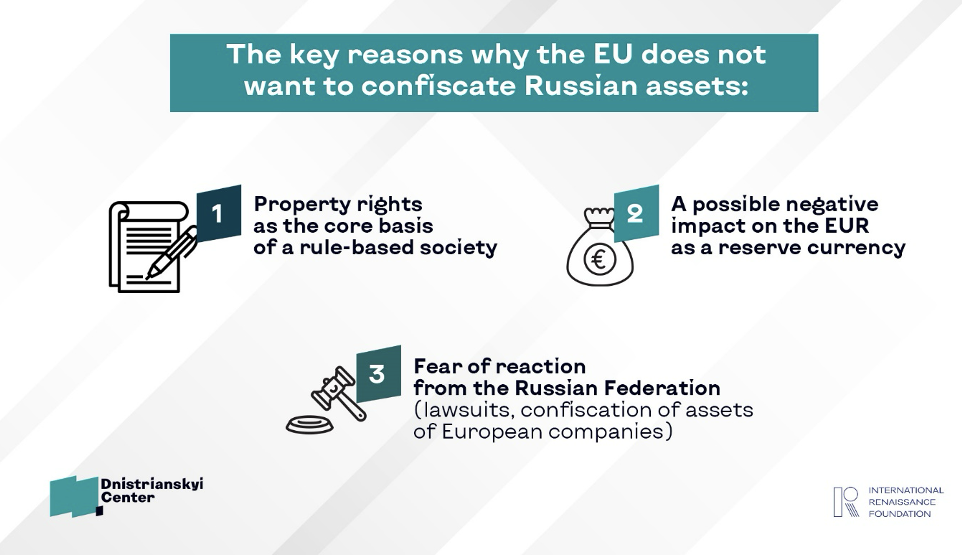
In fact, it formalizes the EU’s position in the ongoing debate on whether these revenues can be treated separately from assets and whether they can be disposed of without regard to sovereign immunities. Such doubts, in particular, were most often voiced by representatives of France and Germany.
“We don’t have the legal basis to seize the Russian assets and we should never act if we don’t obey by the international law and by the rule of law, We should really understand that taking such significant decision, which is to take advantage of the state property, needs a very strong legal basis”, - stated this February the Minister of Economy and Finance of France, Bruno Le Maire.
It is important to note that the decisions provided for in the May 21 Regulation apply only to assets received after February 15, 2024. Those received before this date will remain immobilized and their fate will remain uncertain.
In this regard, depositories of the CBR reserves in excess of EUR 1 million are required to keep the revenues received from them in a separate account separate from the principal. Of this amount, they can retain 0.3% “to ensure the efficiency of their work”, in fact, to cover overhead costs associated with asset management.
Furthermore, depositories will be able to temporarily retain 10%of the principal amount of revenues for “risk management in view of the impact of the war in Ukraine”, but if they are not used within 5 years, a decision may be made on the further need to retain these amounts or transfer them to the EU in whole or in part. The amount of this percentage may be changed if the European Commission considers it too high or if depositories request an upward revision.
In fact, these funds will be used to finance potential claims in which Russia may challenge actions regarding the profits from the CBR assets. Although international experts doubt that Russia will go to court, Kremlin officials have already stated that this is an option.
“We will use all possible judicial mechanisms, those that are available now and those that will become available in the future”, Putin's spokesman Dmitry Peskov recently said.
As for the scheme of use of these assets, it provides that 100% of the amounts to be used for the benefit of Ukraine should be transferred to the Ukraine Facility Plan. At the same time, in order to “respond to unforeseen situations or to new events and needs”, it is allowed that up to 10% annually may be allocated to other needs – it is expected that this will be financing Ukraine’s military needs.
.jpg)
What is next
The implementation of this idea is currently the greatest success in the process of using Russian assets or revenues from them in the interests of Ukraine. It is not offset by the fact that the amounts in question (EUR 3–5 billion annually) are relatively small in relation to the total amount of frozen assets of the CBR, and especially in relation to the total amount of damage caused by the Russian aggression and Ukraine’s current financing needs.
In political terms, this step is the first practical decision on the fate of Russian Federation’s sovereign assets. Given the simultaneous adoption of the REPO bill in the United States, this decision sends a powerful signal to the Putin administration that our allies are ready to take decisive action to confiscate the CBR assets.
On the other hand, there is a certain risk that these steps will be the maximum that Ukraine can hope for in this regard for a long time. Legal arguments and a lack of political will may delay further steps, and this decision can be used as evidence that much has already been done for Ukraine in this direction.
Another aspect is that the approach taken by the EU is not intended to provide compensation for damages, but rather to finance ongoing support and reconstruction of Ukraine. Financing compensation payments to victims of Russian aggression and to Ukraine as a state remains an unresolved issue.
That is why Ukrainian diplomacy and civil society should continue to advocate for the complete confiscation of the CBR reserves and their transfer to an international compensation mechanism. In this context, the decisions of the next Group of Seven (G7) summit will be important, as it may decide on the fate of Russian Federation’s assets, including the issuance of “reparation bonds” secured by the assets themselves or future profits from them.
The material was prepared with the support of the International Renaissance Foundation as part of the project "#Compensation4UA/Compensation for war losses for Ukraine. Phase III: Advocacy of steps to guarantee a sustainable compensation strategy"