May 22, 2023
Compensation for Ukraine: Results of the First Year of Work on the Creation of Compensation Mechanisms
© Dnistrianskyi Center
The process of compensation for damage caused to Ukraine by Russian aggression may become unprecedented in the history of international politics and law. And this is not only about quantitative measurement (which is hundreds of billions of dollars of damage) but also about making complex political and legal decisions.
To put into praxis such compensation, it is necessary to solve three main tasks:
- develop appropriate legal and institutional mechanisms;
- receive the support of partner countries in the creation of an international compensation mechanism;
- provide financing of war damage compensation, including through the transfer of Russian assets for compensation to Ukraine.
They began to speak about the war damage reparations almost immediately after the beginning of a full-scale aggression of the Russian Federation. For some time, representatives of the Ukrainian authorities expressed the expectation that it would be simple and quick to receive Russian assets as the compensation for damage as a result of aggression. However, almost immediately, the states that control the frozen assets of the Russian Federation began to voice, at least, cautious statements about the feasibility of a simple and quick scenario. It became clear that systematic and deep work is needed in that regard.
The date of the formal beginning of such work of the Ukrainian authorities was May 18, 2022, when Volodymyr Zelenskyy by his Decree created the Working Group on the development and implementation of international legal mechanisms for compensation for damage caused to Ukraine as a result of the armed aggression of the Russian Federation. Andrii Yermak was appointed the head of that Group, and the heads of the negotiating group on the creation of such mechanisms became Deputy Minister of Justice Iryna Mudra and well-known Ukrainian lawyer Markiian Kliuchkovskyi.
That Group became the main center for the development of potential solutions and scenarios of how Ukraine could receive the war damage compensation. The next day, May 19, three members of that Group – Chiara Giorgetti, Markiian Kliuchkovskyi, and Patrick Pearsall – published the position paper entitled “Creation of the International Special Commission for Ukraine,” which outlined the Ukraine’s vision of the future institutional damage compensation mechanism. The basis of that mechanism would be a special international Commission, which:
could serve three main purposes: (i) to adjudicate compensation claims; (ii) to preserve or collect Russian assets for payment of awards; and (iii) to provide means for enforcing compensation decisions.
Subsequently, this concept was developed into a draft international compensation mechanism. Its four main components are:
- an international commission to review compensation claims and administer the process;
- the compensation fund from which payments are to be made;
- an international register of damage, in which evidence of the damage caused must be recorded;
- a special procedure on the basis of an international treaty.

The model for that compensation mechanism concept was the UN Compensation Commission, established after Iraq’s aggression against Kuwait and occupation of the latter in 1990–1991. However, we are not talking about the automatic transfer of the practice of this Compensation Commission to Ukrainian realities. In particular, it is worth taking into account the negative experience of this body, for example, the high threshold of proof of losses for victims, through which a relatively small number of claims were satisfied: $52.4 billion out of the declared $353 billion.
During the year, the Ukrainian government, the Working Group members, and civil society actively worked on the implementation of that concept. The main tasks were: providing international support for the creation of an international compensation mechanism for Ukraine and obtaining consent for the confiscation and transfer of Russian assets to Ukraine to finance compensation, as well as working on the confiscation of assets related to the Russian Federation directly in Ukraine.
International support
Providing international support has become perhaps the most important task and brought perhaps the greatest success. It was necessary to overcome the constant resistance of the Russian Federation, its partners and satellites, to look for new formats of solutions that would allow Ukraine to start the process of war damage compensation.
The most successful precedent for the war damage compensation is the creation of the UN Compensation Commission which dealt with compensation for the consequences of Iraq’s aggression against Kuwait. That Commission was established by the decision of the UN Security Council, which is binding on the member states. However, in the case of Ukraine, such a scenario is practically impossible, since Russia and, probably, China will block such a decision using the veto.
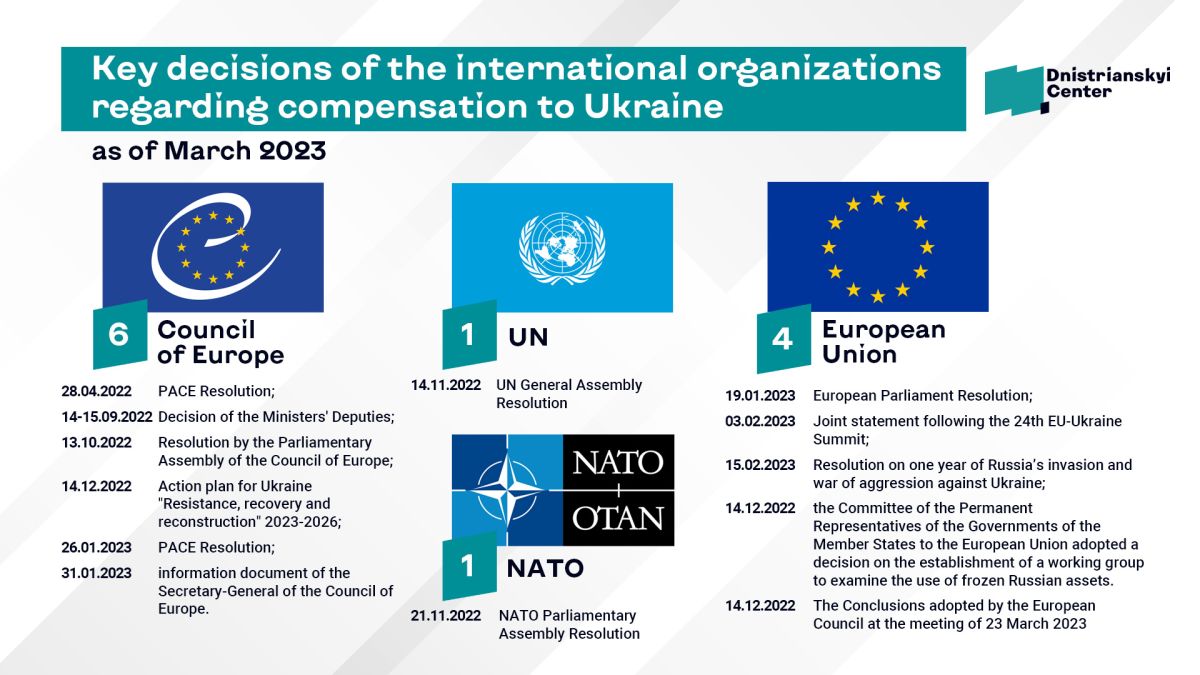
Instead, within the UN framework, the Resolution of the General Assembly of November 14, 2022, was adopted which recognized the obligation of the Russian Federation to compensate Ukraine for damage due to aggression. At present, this is the most authoritative international document that supported Ukraine’s right to compensation for damage due to Russian aggression and recognized Russia’s obligation to compensate for it:
The General Assembly … recognizes the need to establish, in cooperation with Ukraine, an international mechanism for the compensation of loss, damage, and injury arising from the international wrongful acts of the Russian Federation in and against Ukraine.
The General Assembly called on the member states to work together with Ukraine to establish the International Register of Damage which would collect information and evidence on the damage caused, as well as contain the compensation claims.
At the same time, it should be noted that of all the votes on Russian aggression against Ukraine after February 24, that Resolution received almost the slightest support from the member states of the General Assembly: only 94 voted for it, 13 opposed, and 74 abstained. There is a risk that in the event of future votes to compensate Ukraine for damage, it may be more difficult to find support within the United Nations framework.
(1).png)
Source: UNWatch
However, it was with the Resolution of November 14, 2022, that there began support for compensation to Ukraine at the level of international organizations. Shortly thereafter, the creation of an international compensation mechanism for Ukraine was supported in resolutions of the NATO Parliamentary Assembly, the European Parliament, and the Parliamentary Assembly of the Council of Europe. The latter, dated January 26, 2023, is especially important, since the Assembly stated in it that it is the Council of Europe that is actually ready to create such a mechanism under the auspices of the Council of Europe:
The Assembly reiterates its call on all member states of the Council of Europe to establish an international compensation mechanism, including the International register of damage, in cooperation with the Ukrainian authorities. The Assembly considers that the Council of Europe should play a leading role in the establishment and management of the future mechanism.
However, all these resolutions are of a recommendatory nature and do not constitute binding legal grounds for the establishment of such a mechanism.
The first, and currently the only, decision that will have real consequences for the launch of the process of damage compensation for the aggression of the Russian Federation against Ukraine was the decision to create the Register of Damage Caused by the Aggression of the Russian Federation Against Ukraine within the Council of Europe framework.
Register of Damage
The decision to create the Register of Damage is the main achievement of the year of work on the international dimension of the war damage compensation to Ukraine. The call for its creation was contained both in the UN Resolution of November 14, 2022, and in the resolutions of the European Parliament and PACE. The main efforts of the Ukrainian government and the Working Group were concentrated particularly on the Register creation.
At the beginning of 2023, it was actually recognized that the Register creation should be the first step on the way to war damage compensation. The PACE, in its Resolution of January 26, 2023, stressed that
the Register of Damage should be a record of evidence and claims for damage, losses, or injury caused to all individuals and legal entities in Ukraine, as well as to the state of Ukraine as a result of the aggression of the Russian Federation against Ukraine, which is a violation of international law.
Subsequently, it was possible to come to a common understanding of certain technical aspects of the Register’s operation. On February 17, 2023, the Ministry of Justice of Ukraine announced that the Dutch government had given its “consent in principle” to create in The Hague the Register of Damage Caused to Ukraine by Russian Aggression.
Three months later, in May 2023, a decision was received to create the Register. During the Council of Europe’s summit, on May 17, in Reykjavik, 40 member states of that international organization, the United States, Canada, Japan, and the EU signed an agreement on the Register creation (it is possible to expand the membership of the parties to the treaty). The Prime Minister Denys Shmyhal said,
We are grateful to the Council of Europe and all member states for such a high level of support. We invite other states from all over the world to join the Register of Damage in support of the important issue of Russia’s responsibility for the war against Ukraine.
The Register is created under the auspices of the Council of Europe, with headquarters in The Hague and an auxiliary office in Kyiv. It will be headed by the Executive Director, nominated by Ukraine, and the Board, seven members of which will decide on the admissibility of the compensation claims which will be filed by the victims and entered into the Register of Damage.
However, the creation of the Register and its subsequent work is only one of the necessary steps towards the creation of the international compensation mechanism. The Register Statute itself emphasizes that it is not empowered to award compensation, establish liability for damage, or perform any adjudication functions. The agreement on the creation and the Register Statute stipulate that it is intended to be only the first component of the compensation mechanism. Whether there is progress in the creation of other elements of the compensation mechanism, which were discussed above, namely, the international treaty, the special Commission, and the Compensation Fund, is not yet known (we can learn about this suddenly, as we learned about the Register creation).
The Register creation opens up the possibility of collecting and recording evidence of damage caused by Russian aggression and claims for its compensation, but does not guarantee that compensation will be paid. To do this, it is necessary to create mechanisms for the confiscation of assets related to the Russian Federation, which are now blocked abroad.
At the same time, there are a number of organizational and technical issues for the future operation of the Register, the key of which is that it can only include evidence and claims for damage caused starting from February 24, 2022. This approach raises doubts in light of the fact that Ukraine consistently insists that the aggression began in February 2014.
Confiscation of Russian assets in other countries
The mentioned position paper of May 19, 2023, stated that no compensation mechanism “can be considered fully successful without adequate funding for the payment of compensation.” One shouldn’t expect that Russia will voluntarily agree to pay reparations, while public and private Russian assets abroad, much of which have already been frozen, may well be viewed as a source of such funding.
However, the state assets of the Russian Federation (and this is primarily the Central Bank of Russia’s reserves) are subject to the state immunity which protects this property from confiscation in court. Some representatives of the Ukrainian authorities and the expert community express doubts in private conversations that the stated amount – about $350 billion – is true.
As for private assets, despite the significant number of sanctions imposed on persons involved in Russian aggression and the seizure of their assets, in the vast majority of cases, at this point, this is not about confiscating and transferring this property to Ukraine to compensate for the war damage. The very fact of imposing sanctions does not automatically become grounds for confiscation, and confiscation in the framework of ordinary criminal proceedings can take a long time and leaves open the question of whether these funds will subsequently be transferred to Ukraine.
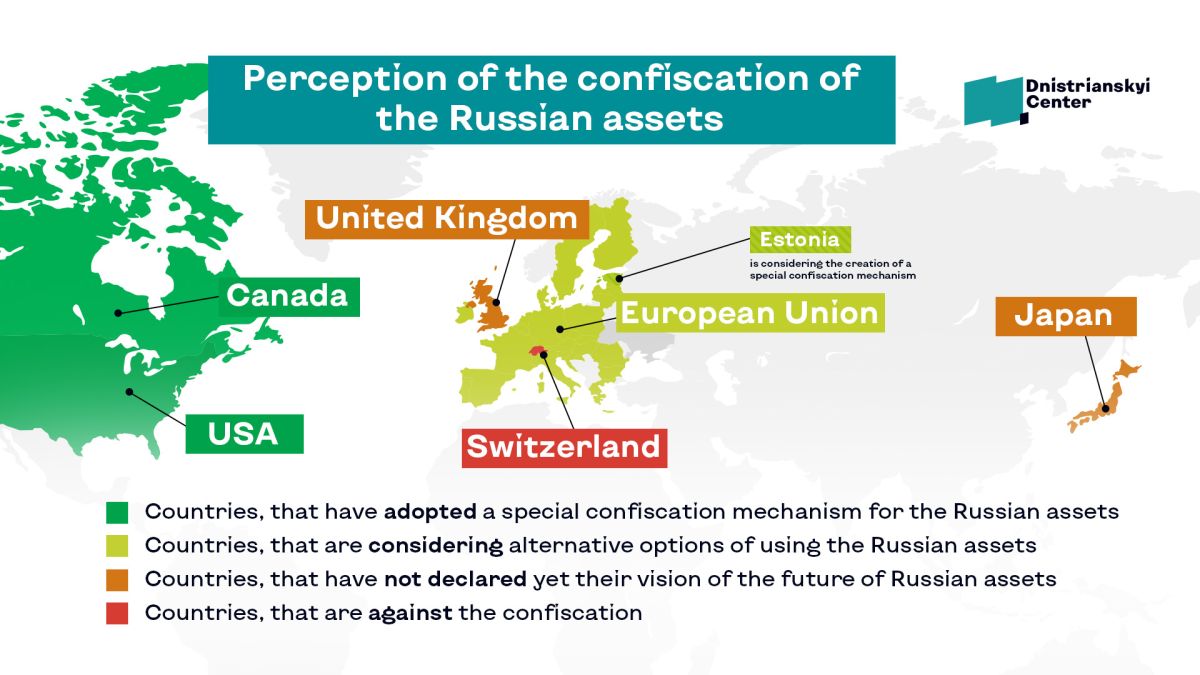
In order to solve that problem, the national legislation first of Canada (in June 2022), and later in the United States (in December of the same year) was supplemented with special mechanisms that allow the confiscation of property of sanctioned assets if their participation or support for aggression against Ukraine, attempts to circumvent sanctions, etc. is proven. However, at the moment, the most significant, and perhaps the only real precedent for the use of those special mechanisms was the confiscation of $5.4 million of Russian oligarch Konstantin Malofeev in the United States in February 2023 and their transfer to Ukraine in May of the same year. US Attorney General Merrick Garland commented on the transfer of Malofeev’s money, “The confiscated funds will be transferred to the State Department in support of Ukraine’s people. Russian war criminals will not find refuge in the United States.”
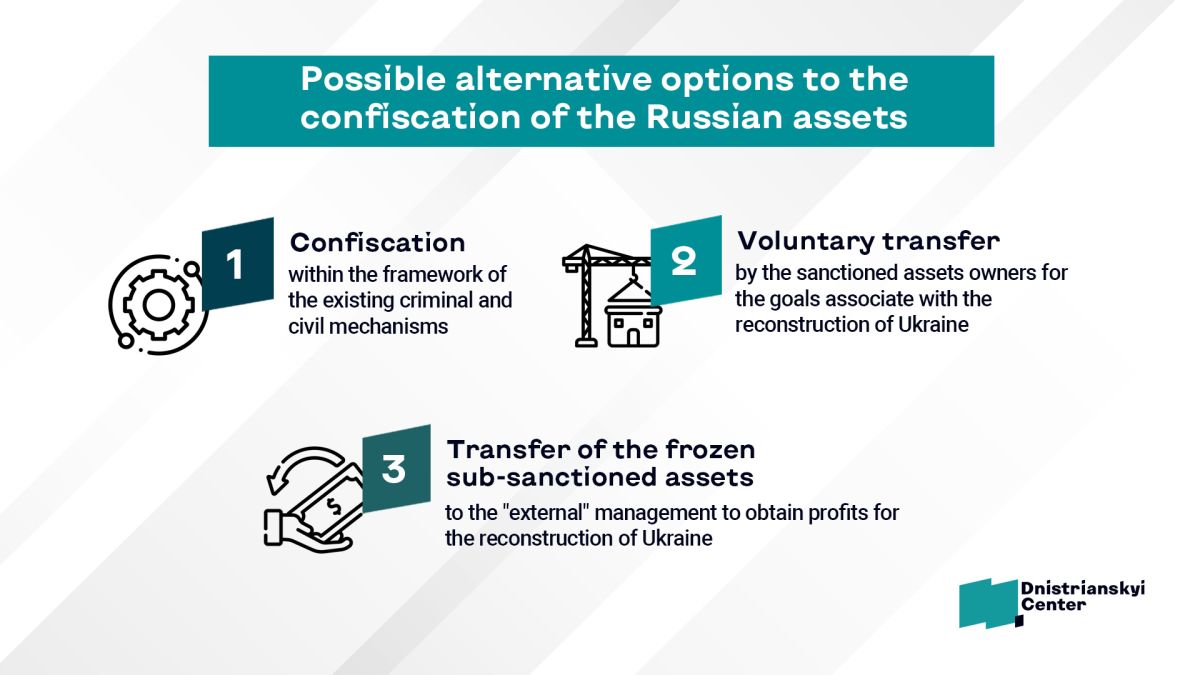
In the European Union, the creation of such a special mechanism is not currently in question. Two options for the Russian assets’ future are being discussed: 1) strengthening the responsibility for circumventing sanctions, which may be the basis for confiscation, or 2) creating a special body that will use these assets, and the obtained profits will be directed to Ukraine. At the same time, European diplomats and officials periodically say that the frozen assets will eventually have to be returned to Russia. Ursula von der Leyen stated on November 30, 2022, on the support for the latter option:
We have blocked 300 billion euros of reserves of the Russian Central Bank and frozen 19 billion euros of Russian oligarchs. In the short term, we could create a structure with our partners to manage these funds and invest them. Then we would use the funds received for Ukraine.
In the statement of the G-7 following the summit in Hiroshima, they also emphasized the “using” as the leading form of work with Russian assets:
“We will also explore other viable options to support Ukraine’s humanitarian needs, rapid recovery and reconstruction, including the use of frozen Russian assets in accordance with our national laws.”
An important step towards the confiscation of Russian assets was made in the UK as well. In early May 2023, a draft amendment to the legislation that would allow the confiscation of Russian private assets was introduced in the House of Lords.
The author of the document, Lord Alton, explained that the amendment obliges Russian oligarchs who were on the British sanctions lists due to the war of the Russian Federation against Ukraine to declare the amount of assets stored in the UK and operations carried out with them within six months before the sanctions were imposed. If it turns out that the Russians did not declare all the property, provided false information, or made attempts to circumvent the sanctions, this will serve as a legal basis for confiscating their assets and transferring them to Ukraine.
The main reason for the partner states’ cautious approach to the confiscation and transfer of private Russian assets to Ukraine is the importance of property rights in their societies. The Ukrainians who have gone through decades of the communist regime sometimes find it difficult to perceive that the confiscation of the aggressor’s property can be such a difficult legal and moral step for the societies of our partners because there it would be considered as a gross violation of the right to private property. Similarly, in the case of state assets of the Russian Federation, the violation of state immunity can cause distrust in relations between states and lead to chaos in world politics and the economy.
For most of our partners, the most comfortable scenario is the interpretation of the frozen assets of the Russian Federation as a “lever,” which in the process of political settlement will force the Russian Federation to agree to pay the reparations. Thus, in the same statement of November 30, Ursula von der Leyen said that “after the lifting of sanctions, these funds [frozen assets of the Russian Federation] should be used by Russia to fully compensate for the damage caused to Ukraine.” In other words, the frozen assets of the Russian Federation are considered only as a means of diplomatic pressure and are not intended to be confiscated in favor of Ukraine.
As the decisions on the supply of weapons to Ukraine show, our partners are gradually moving away from illusions about the Russian Federation and start making pragmatic decisions. We must work hard to change their vision of the Russian assets’ fate. However, one should be flexible and ready to consider various options for using the frozen assets of the Russian Federation.
National compensation instruments
At the national level, Ukraine is developing legislative compensation mechanisms and is engaged in the search and confiscation of Russian assets to finance compensation.
The first bills on the war damage compensation appeared in Ukraine a year before the full-scale aggression – in the winter of 2021. And in the first months after February 24, 2022, two more alternative projects were submitted to the Verkhovna Rada, one of which – No. 7198 – was adopted as the Law of Ukraine “On Compensation for Damage and Destruction of Certain Categories of Immovable Property as a Result of Hostilities, Terrorist Acts, and Sabotage Caused by the Armed Aggression of the Russian Federation against Ukraine.”
This Law “determines the legal and organizational basis for providing compensation” for destroyed and damaged housing, as well as the basis for creating and maintaining the State Register of Property Damaged and Destroyed as a Result of Hostilities, Terrorist Acts, and Sabotage Caused by the Armed Aggression of the Russian Federation against Ukraine. This Law is imperfect, but it is an important first step towards ensuring the rights of victims to compensation, albeit only in a separate area.
In turn, the Supreme Court, in its decisions of April 14 and May 18, 2022, took steps to derogate from the doctrine of sovereign immunities in the case of Russian assets located in Ukraine. These decisions are important, but from a legal point of view, they require a more complete justification, which the Supreme Court judges themselves recognize in public speeches. In addition, the decisions on the recovery of damage caused by the Russian Federation, adopted by the Ukrainian courts, currently do not have an understandable mechanism of execution.
The greatest progress has been made towards the confiscation of private Russian assets blocked in Ukraine. The High Anti-Corruption Court, at the suit of the Ministry of Justice, has already made about 20 decisions on the confiscation of assets belonging to Russians or related persons in Ukraine. The most resonant were the decisions in the cases of Vladimir Yevtushenkov, Mikhail Shelkov, the Rotenberg brothers, and others. The confiscated property is transferred to the management of the State Property Fund and can be sold to finance the war damage compensation.
Although the HACC’s position in some aspects is not indisputable, and the management of seized and confiscated assets raises questions, the very fact of making decisions on confiscation is a significant proof of the seriousness of Ukraine’s intentions in this direction. It is also a signal to the international community that we are not only demanding but also taking practical steps.
The process of forming a policy for the war damage compensation does not end with the adoption of the mentioned laws and decisions on confiscation. The Verkhovna Rada is currently considering the draft Resolution “On Peculiarities of Legislative Regulation of the Principles of Providing Compensation for Victims of Armed Aggression of the Russian Federation Against Ukraine” and the draft law “On Basic Principles of Providing Compensation for Victims of Armed Aggression of the Russian Federation.” They aim to create a more general framework for compensation in normative and institutional terms.
However, the formation of national mechanisms in this area directly depends on progress at the international level. The creation of the Register of Damage may give impetus to more active work within the country.
What’s next?
It is currently difficult to comprehensively assess the work that has already been done and continues to be carried out by Ukraine to ensure the war damage compensation. The activities of the Working Group created by the Presidential Decree a year ago are quite closed and non-public, which, from a certain point of view, is justified due to the political sensitivity of the process. Probably, the progress is greater, but we have until now learned about the actual results from public statements and decisions.
For example, the fact that the Register would be created under the auspices of the Council of Europe at the summit in Reykjavik, became known from Twitter of the President of the European Commission Ursula von der Leyen only on May 15, 2023. Perhaps if that decision had been discussed for a long time in public space, it would not have received such high support.
Therefore, the greatest success of the first year of work on ensuring the war reparations to Ukraine is the decision to create the Register of Damage. Despite the fact that this is the first and so far the only practical step on this path, it should not be underestimated: in the face of ongoing aggression and strong diplomatic resistance from the Russian Federation, its allies, and satellites, this is a truly outstanding result.
Other elements of the compensation mechanism for Ukraine – the conclusion of an agreement on the creation of the international compensation mechanism for Ukraine, the format of the work of the Commission or the Compensation Fund – are not mentioned in the public space. The Prime Minister of Ukraine Denys Shmyhal and the Chairman of the Verkhovna Rada of Ukraine Ruslan Stefanchuk spoke about the need to conclude such an agreement and about certain ideas for its content at the United for Justice conference of the Legal Ramstein in March 2023 in Lviv.
Though often and from different sources one voices the theses about the need to create the Recovery Fund, where the funds confiscated from Russia and Russian oligarchs should be directed, it is still not clear whether we are talking about the proposed Compensation Fund within the framework of the international compensation mechanism, or this Fund is considered as a separate structure. In the end, the processes of compensation and restoration and reconstruction are also separate: the first concerns responsibility for aggression and war crimes, the second concerns the country reconstruction strategy, including with the help of both funds received from compensation and donor funds.
It should be borne in mind that future compensation mechanisms for Ukraine may have a different configuration than that currently promoted at the level of the Ukrainian government (the special commission, fund, register, and the international agreement that defines principles and procedures). It can be assumed that partly this understanding exists at the official level as well, although it is not voiced publicly.
Thus, although the agreement on the Register creation repeatedly emphasizes its connection with the future compensation mechanism, the verb may is used, not will (will become). This indirectly indicates both doubts about what format of the mechanism will be created and that the parties want to leave room for maneuver in this difficult process.
It is the conclusion of an international agreement on compensation to Ukraine that can become a key stage of this process. It has to solve several tasks at once:
- To establish institutional mechanisms for damages and integrate those already established, in particular the Register of Damage.
- To solve the problem of state immunity with respect to state assets of the Russian Federation, including the Central Bank’s reserves, and to develop a procedure for transferring these assets to Ukraine to compensate for damage from Russian aggression.
- To establish clear procedures and guarantees of compensation, the circle of persons who can claim it, etc.
The format of this agreement is not yet clear. It is likely that it can again be concluded within the framework of the Council of Europe. The participation of the international organization in ensuring the process of compensation to Ukraine is a very positive signal, but there are doubts whether the Council of Europe will be the most institutionally able to guarantee the achievement of the practical goals of compensation when taking the next steps. The EU or the UN could be more effective in this sense, but because of the position of individual members (primarily Hungary in the EU, Russia and China in the UN), their leading role in this process is unlikely.
Ukraine needs to continue to put pressure on the states-managers of Russian assets in order to reach decisions on their confiscation and transfer to Ukraine. These decisions would be unprecedented, but the scale of the aggression and crimes of the nuclear state and a permanent member of the UN Security Council is such that it allows us to talk about a departure from the practice that has developed so far. The adoption of a multilateral decision on the confiscation of Russian assets, including the reserves of the Central Bank of the Russian Federation, will testify to the awareness of the uniqueness of the situation and will be a guarantee that such arbitrary decisions will become impossible in the future.
Under any circumstances, it should be recognized that the process of creating institutional mechanisms and ensuring compensation to Ukraine will be long.
Goals for the next year
The first year of the process of creating institutional mechanisms for compensating Ukraine for the damage caused by Russian aggression is ending optimistically, but the second year may bring the achievement of many tactical goals with no strategic solution found. It seems that a great success as of May 2024 would be the following:
- Launching the Register of Damage at the level of the institutional mechanism: opening offices in The Hague and Kyiv, appointing its key bodies (the Council, the Executive Director), and starting practical work on receiving and processing claims for compensation for damage, involving new members in the agreement on its creation, so that more than half of the UN member states are members of it.
- Adoption of a decision similar to the agreement on the Register creation regarding one of the declared elements of the international compensation mechanism – the international agreement, special Commission, and the Compensation Fund or other instruments in case of a change in the concept of the compensation mechanism for Ukraine.
- Formation of a common vision with the states-managers of frozen Russian assets to solve the problem of sovereign immunities against state assets of the Russian Federation and the Central Bank’s reserves.
- Creation of a special mechanism for the confiscation of Russian assets in connection with the aggression against Ukraine within the European Union and the United Kingdom, similar to the confiscation mechanisms implemented in the United States and Canada.
- Streamlining the practice of confiscation of assets of the Russian Federation and Russians and their management in Ukraine at the level of the Ministry of Justice, HACC, and ARMA (Asset Recovery And Management Agency) to ensure undisputed decisions, transparency of the process, and trust in it.
- Resolving the uncertainty with the date on which the compensatory mechanism jurisdiction will apply: from February 24, 2022, or from February 2014. This is a political issue, since the Ukrainian government consistently insists on the beginning of Russian aggression. On the other hand, it is necessary to have a vision of compensating for the damage of the affected residents of the Crimea and Donbas, including businesses that lost property after the occupation of the Crimea and the beginning of aggression in the Donbas in 2014.
- Increasing transparency and publicity of government policy on the creation of compensation mechanisms for Ukraine. Although this topic, as we have already emphasized, is politically sensitive, advocacy and communication of other sensitive issues, in particular the supply of weapons, is much more public. This approach will help to increase confidence in the process and future decisions and mechanisms in the long term.
This does not mean that in the next year, work on ensuring compensation for Ukraine should focus only on these goals. We will be glad to be wrong and to admit in a year that our expectations were underestimated.
Full justice for Ukraine is impossible without compensation for the damage suffered by Ukrainians and our state. The process of war damage compensation in world practice is in principle political, so concrete and practical decisions should be expected when a political settlement begins. Therefore, the most important factor that affects the implementation of plans for compensation to Ukraine is the success of the Armed Forces of Ukraine and the aggressor’s defeat.
The publication was prepared with the support of the International Renaissance Foundation as the part of the project "#Compensation4UA/Compensation for war losses for Ukraine. Phase II: ensuring the effectiveness of mechanisms at the national and international level" project.