May 21, 2025
Compensation for Ukraine: Results of the Third Year of Work on Creating Compensation Mechanisms
May 18 marked three years since the issuance of the Presidential Decree by Volodymyr Zelensky establishing the Working Group on the Development and Implementation of International Legal Mechanisms for Compensation for Damage Caused to Ukraine as a Result of the Armed Aggression of the Russian Federation. This date can be recognized as the starting point of the Ukrainian government’s diplomatic efforts to secure compensation for the losses suffered by Ukraine and its citizens.
As in previous years, the Dnistrianskyi Center has prepared an overview of the key developments and decisions in this area over the past year, highlighting both the progress made and the challenges that remain.
Reports for 2023 and 2024 are available at the links provided.
International Compensation Mechanism
From the outset of its efforts to secure compensation for damages, Ukraine emphasized the need to establish a dedicated Compensation Commission as an institutional mechanism to address the harm caused by the Russian Federation’s aggression. Over time, this concept evolved into a broader vision of an international compensation mechanism, comprising three core elements: a Register of Damages, a Claims (Compensation) Commission, and a Compensation Fund.
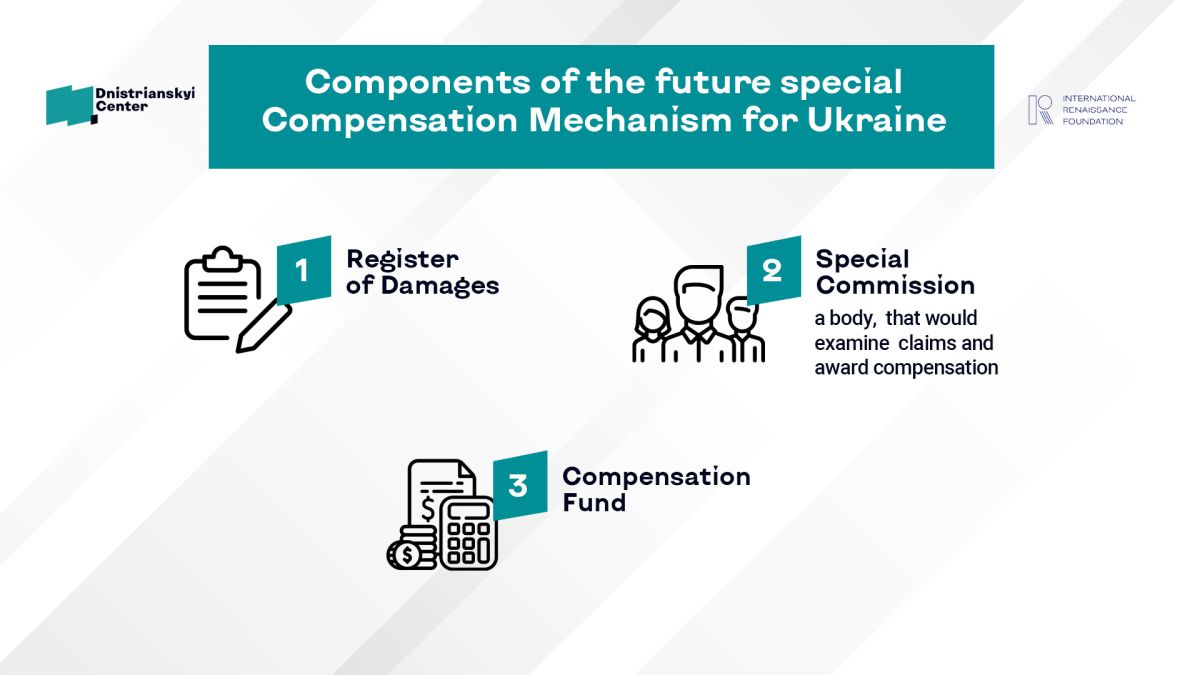
The creation of such an ad hoc mechanism is necessary due to the absence of permanent international instruments capable of effectively addressing compensation for damages resulting from internationally wrongful acts. The proposed structure follows a well-established model, particularly when compared to the UN Compensation Commission.
The Register of Damages for Ukraine, established in May 2023, is the first element of this emerging mechanism. After two years of groundwork, it began accepting applications from victims. As of May 2025, claims are being accepted in 10 out of the 43 designated categories—an important achievement, especially considering the ongoing nature of Russian aggression.
A key feature of the Register is its commitment to a victim-oriented approach, prioritizing the interests of individuals who have suffered losses. Representatives of the Register have confirmed that opening all claim categories to individuals remains a central goal at this stage.
Significant progress has also been made over the past year toward establishing the Claims (Compensation) Commission for Ukraine. Four preparatory meetings were held in The Hague—in July, September, and November 2024, and in January 2025. It is anticipated that, like the Register, the Commission will be established under the auspices of the Council, as part of a unified institutional framework.
The next milestone in creating the Commission is the conclusion of the Agreement on the Establishment of the International Commission for the Consideration of Applications for Ukraine. Presidential Decree No. 177/2025, issued on March 24, 2025, approved the composition of the Ukrainian delegation for negotiations, headed by Deputy Head of the Office of the President Iryna Mudra. The first two rounds of negotiations were held in The Hague in March and May 2025.
However, securing broad international support remains a considerable challenge to building a fully functioning compensation mechanism. Invitations to join the Commission will be extended to the 94 countries that supported UN General Assembly Resolution A/RES/ES-11/5 of November 14, 2022, which recognized Ukraine’s right to compensation for damage caused by aggression.
Yet, as demonstrated by the Register of Damages, participation from non-European states remains limited. Among the 41 current participants, only three—Canada, the United States, and Japan—not belong to Europe. For many countries in other regions, international compensation mechanisms are often viewed primarily through a financial lens, rather than as instruments of justice. This perception has been confirmed through the Dnistrianskyi Center’s ongoing dialogue with diplomats from those regions.
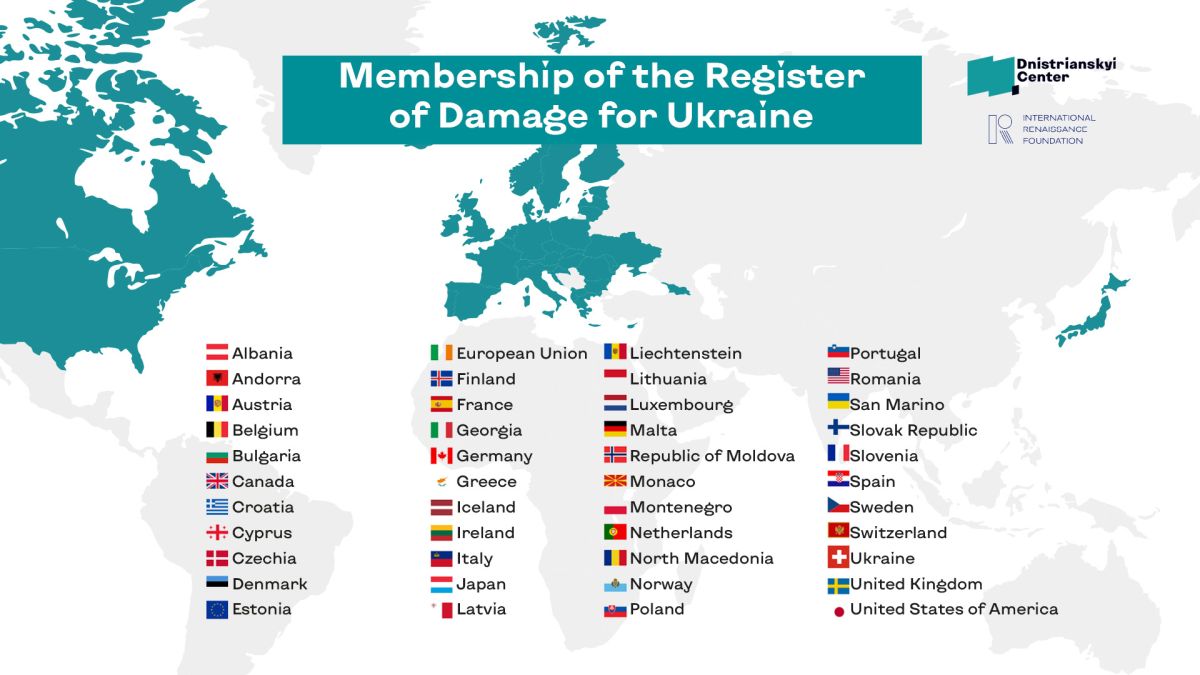
Overcoming this narrow perception and ensuring global participation—both in the Register and the Commission—is a key task for Ukraine’s diplomatic corps and engaged civil society actors.
Another major issue is the temporal jurisdiction of the mechanism, which currently covers a only a period after February 24, 2022, thereby excluding victims of Russian aggression between 2014 and 2022. According to Iryna Mudra, work is underway to address this gap.
“Selective justice is not justice. Compensation must cover all the damage caused by Russia—starting from 2014. The illegal annexation of Crimea, the war in Donbas, the first killed, the first captured, the first destroyed homes—this is not prehistory. This is the beginning of a great tragedy that continues to this day,”
— Iryna Mudra, Deputy Head of the Office of the President of Ukraine
According to representatives of the developing mechanism, the Claims (Compensation) Commission is expected to be established by the end of 2025, and the Compensation Fund, the third component, by the end of 2027.
Nonetheless, beyond institutional development and political support, a critical issue remains: the ability to ensure actual disbursement of awarded compensation. As rightly noted at the early stages of this initiative, “no international claims commission can be considered entirely successful without appropriate funding for paying awards”/
Confiscation of Russian Assets
At this stage, the only realistically available and primary source of compensation for Ukraine and Ukrainians remains the frozen reserves of the Central Bank of Russia. These assets are estimated at approximately $300 billion, with about $210 billion held in European central depositories — primarily Euroclear (Belgium) and Clearstream (Luxembourg).
Since May 2024, Ukraine has made tangible progress in leveraging these frozen assets. In particular, the state has already begun receiving interest income accrued on the placement of these funds in European central depositories. Moreover, in July 2024, the Group of Seven (G7) decided to provide Ukraine with a so-called “reparation loan” (Extraordinary Revenue Acceleration or ERA Loans) amounting to $50 billion. This loan is secured by the income generated from the frozen Russian assets and is expected to be repaid from those revenues in the future.
However, the full confiscation of these assets and their transfer to Ukraine is not currently on the political agenda. Although a clear and well-reasoned legal basis for such action has already been articulated, political will—particularly within the European Union—remains lacking. A key complicating factor is that two-thirds of these frozen assets are under EU control, giving the European community a powerful tool of leverage in shaping the peace process aimed at ending Russian aggression and achieving a sustainable resolution.
The situation is further complicated by the de facto blocking of related initiatives by the new U.S. administration. Notably, the United States did not support a recent G7 resolution in support of Ukraine. This casts doubt on the oft-repeated G7 position that "Russia’s sovereign assets in our jurisdictions will remain immobilized until Russia pays for the damage it has caused to Ukraine."
During peace negotiations earlier this year, rumors emerged that Russia was willing to allow its frozen assets to be used for Ukraine’s reconstruction—on the condition that part of the funds be directed to the needs of temporarily occupied territories of Ukraine. This approach is categorically unacceptable for Ukraine, as it undermines the principle of international legal responsibility and attempts to legitimize the aggressor’s control over Ukrainian territory.
In the context of confiscation, the purpose to which the assets would be used is also crucial. Ukraine has proposed that the funds be used either for military needs or post-war reconstruction. However, both options, while morally justified, pose significant legal, political, and economic risks—including objections from central depositories, host countries, and compliance frameworks.
Additionally, the use of these assets for military procurement or reconstruction projects may ultimately benefit the supplying states more than Ukraine itself, since they would receive payments under relevant contracts. Particularly concerning is the frequent neglect of the need to fund individual compensation for victims of aggression—an omission that could undermine the integrity and effectiveness of the broader international compensation mechanism, which should serve as the primary instrument for redress.
The optimal solution is the transfer of confiscated assets to the international compensation mechanism, which would ensure transparency, fairness, and efficient allocation of funds. This approach aligns with the doctrine of collective countermeasures, bolsters the legitimacy of confiscation decisions, and places priority on affected individuals. It would also inject funds directly into the Ukrainian economy in a morally, politically, and economically sound manner.
Progress on confiscating private Russian assets has been much more limited. Despite legal developments in Canada and the United States, the only significant precedent to date remains the $5,4 million confiscated from Russian oligarch Konstantin Malofeev and transferred to Ukraine by the U.S.
.jpg)
Canada, a pioneer in developing mechanisms to confiscate assets linked to Russia, only in May 2025 accelerated the process of confiscating an AN-124 cargo aircraft belonging to the Russian airline Volga-Dnepr, which has been arrested at Toronto Pearson Airport since 2022.
The European Union has made the most progress in this area over the past year. Under the 15th sanctions package adopted in late 2024, EU central depositories, in coordination with national regulators, were authorized to unfreeze Russian assets to meet obligations to clients.
In April 2025, it was announced that Euroclear (Belgium) would pay approximately $3.4 billion to European investors as compensation for losses resulting from the blocking and illegal seizure of their assets in Russia. This decision broke the taboo surrounding the confiscation of private assets and may pave the way for broader application of such measures in the future.
However, the fact that these funds went to European investors—and not to Ukraine, which has been calling for the transfer of frozen assets to compensate for war damages for over three years—sends a troubling signal. It is concerning that the EU is ready to act decisively, but primarily in pursuit of its own interests.
Ukraine should seize this precedent to intensify pressure on the EU and demand the transfer of frozen assets to an international compensation mechanism. The core argument remains: the victims of aggression must be the first to receive compensation. At the same time, potential compromises can be explored—for example, allocating a portion of confiscated private assets as compensation for European businesses affected by the war in Ukraine.
Nonetheless, Ukraine’s position must be unambiguous: the primary objective is to secure compensation for the damage caused by the war, and these funds should be confiscated and used strictly for that purpose.
Judicial Practice in Ukraine
In May 2022, Ukraine established a legal mechanism for the confiscation of Russian assets, empowering the High Anti-Corruption Court of Ukraine (HACC) to hear claims brought by the Ministry of Justice. Under this mechanism, confiscated assets are initially transferred to the Agency for Investigation and Asset Management (ARMA) during the consideration phase, and subsequently to the State Property Fund of Ukraine upon final confiscation.
.png)
Over the past three years, this mechanism has proven effective: dozens of confiscation decisions have been issued by HACC. Moreover, both the Ukrainian government and the Supreme Court have responded to legal and civil society criticism by taking steps to improve the legal framework and address procedural deficiencies.
Currently under consideration by the parliament - Verkhovna Rada are two important legislative initiatives:
- Bill No. 13268, which expands ARMA’s powers to manage and dispose of seized assets;
- Bill No. 7520-d, on the Jurisdictional Immunities of Foreign States and Their Property, which addresses limitations on sovereign immunity at the national level.
While it is still premature to assess the final implications of these draft laws, their adoption—depending on their final wording—could significantly impact the operation of Ukraine’s asset confiscation regime.
Another critical issue raised by civil society is the growing number of judgments by Ukrainian courts ordering the Russian Federation and its entities to pay compensation for damage caused by aggression. According to Opendatabot, as of April 2025, Ukrainian courts have issued 1,482 decisions in such cases, and this number continues to grow. While there were only 52 rulings in 2022, the first months of 2025 alone saw 213 new decisions. In 93% of cases, courts fully or partially satisfied the plaintiffs' claims. The largest amount of compensation awarded in a single case to an individual was UAH 328 million, and to a business — UAH 180 billion.
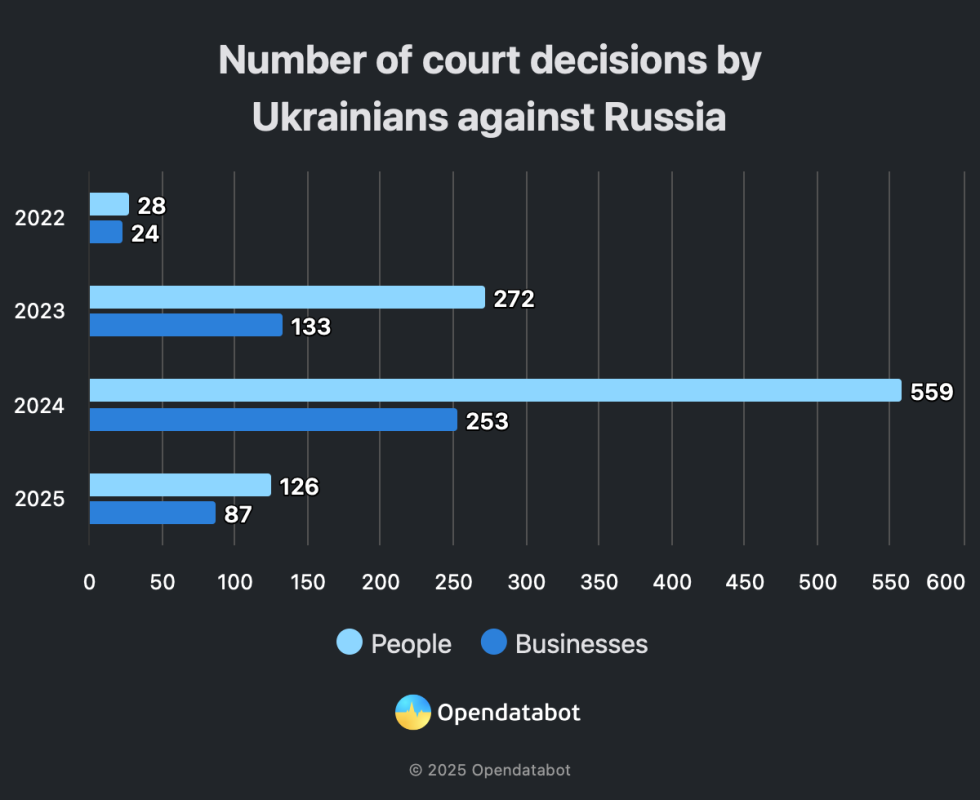
Despite the moral and emotional legitimacy of these decisions, they are currently unenforceable. In the absence of substantive and procedural legislative reforms, Ukrainian courts are operating in a legal vacuum, resulting in symbolic yet legally ineffective rulings. It would be incorrect to attribute this solely to the judiciary — the problem is systemic.
Russia refuses to recognize or enforce these decisions. Meanwhile, Ukraine lacks a sufficient quantity of seizable sovereign Russian assets, and third countries are unlikely to enforce Ukrainian court decisions.
Moreover, the growing number of such unenforceable judgments could erode public trust in the state and the judiciary. There is also a legal risk that the European Court of Human Rights (ECHR) may consider Ukraine’s failure to enforce these decisions as a violation of Article 6 of the European Convention on Human Rights(right to a fair trial).
To address this challenge, Dnistrianskyi Center experts suggest creating an alternative compensation mechanism based on lump-sum payments to victims. The compensation would be calculated approximately in line with what victims might expect from an ECHR judgment. In return, victims would transfer their claims against the Russian Federation to the Ukrainian state. Participation in this mechanism would be voluntary, and the payments could be financed using confiscated Russian assets, particularly through processes handled by the HACC.
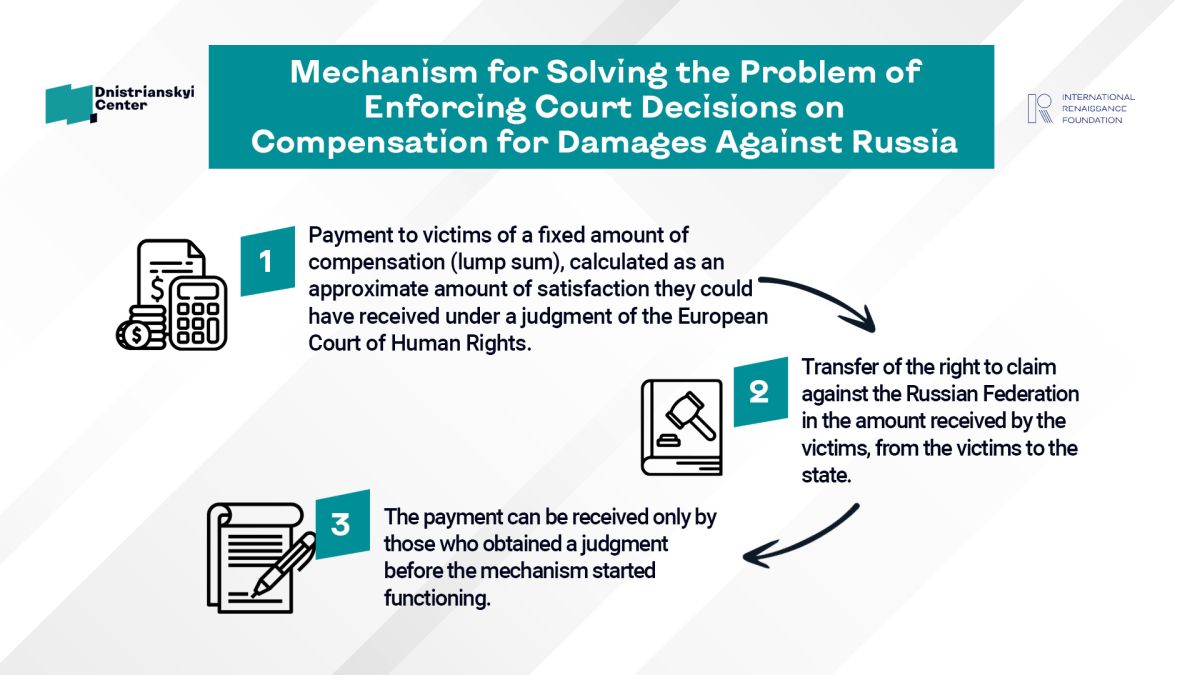
In parallel, legislative amendments are needed, including the adoption of a resolution by the Grand Chamber of the Supreme Court affirming the possibility of derogating from sovereign immunity in cases involving assets belonging to the Russian Federation or its sanctioned nationals.
The primary objective of such a mechanism is not only to protect victims' rights, but also to preserve confidence in Ukraine’s judiciary. Ignoring this problem could have serious consequences, both domestically and internationally. While the proposed model is not perfect, it offers a realistic compromise between moral justice and legal feasibility in the complex context of war.
Ultimately, this issue is part of the broader discourse on interim reparations—a necessary component of Ukraine’s comprehensive approach to post-aggression accountability.
Interim Reparations
In addition to final forms of material and non-material compensation, victims of aggression have urgent and immediate needs arising from the losses they have suffered. So-called interim reparations refer to a form of compensation that involves providing assistance to victims prior to the establishment and full operation of permanent compensation mechanisms.
While the concept of interim reparations is broadly interpreted, Ukraine, given the realities of ongoing full-scale aggression, is not currently in a position to develop and implement a comprehensive national system of such reparations. Nevertheless, individual support programs for victims of Russian attacks—implemented at both the national and local levels—can be seen as preliminary elements or building blocks of an interim reparations framework.
The most notable achievement in this area over the past year has been the introduction of interim reparations for victims of conflict-related sexual violence (CRSV). On May 2, 2024, Ukraine presented the Pilot Project for Providing Interim Emergency Reparations to Victims of Sexual Violence Related to the Armed Aggression of the Russian Federation against Ukraine. This initiative marks an important step toward recognizing the specific needs of survivors of such crimes and delivering targeted, timely support.
The project envisages the development and implementation of a system for providing urgent interim compensation and accompanying reparations to individuals affected by CRSV. As of January 2025, compensation has already been disbursed to 432 individuals out of a planned 500. Moving forward, the project is expected to scale up—both by expanding the categories of victims eligible for assistance and by initiating long-term reparations programs.
In November 2024, the Verkhovna Rada adopted the Law “On Legal and Social Protection of Persons Affected by Sexual Violence Associated with the Armed Aggression of the Russian Federation against Ukraine and Providing Them with Urgent Interim Reparations.”
This law provides a comprehensive legal framework for the recognition, protection, and support of individuals affected by sexual violence in the context of armed aggression. Entering into force on 18 June 2025, it provides for the establishment of a confidential national registry of victims and the creation of a dedicated fund for the payment of urgent compensation. The law also sets out procedures for recognizing victim status and enumerates basic rights, including access to financial assistance, rehabilitation services, legal support, and the guarantee of dignity and respect.
Notably, the law broadens the legal definition of CRSV. It includes not only physical forms such as rape or sexual slavery, but also psychological violence and coercive or degrading acts, including threats, forced exposure, or being compelled to witness acts of violence. Special attention is given to the protection of children born as a result of CRSV, who are also formally recognized as victims.
The development of interim reparations instruments for CRSV survivors is a significant step toward ensuring comprehensive reparations for victims of aggression. Given that the international compensation mechanism is unlikely to become fully operational before the end of 2028—even under optimistic projections—the Ukrainian government must continue expanding its system of interim reparations.
Priority should be given to identifying the most vulnerable groups of victims and designing a comprehensive, inclusive assistance policy. Particular emphasis should be placed on non-material forms of reparations, including the provision of psychological support, the implementation of a national memory policy, and other restorative measures. These elements are essential to ensuring that reparations are not only material but also transformative and holistic in nature.
Conclusions
As with the previous year (May 2023 – May 2024), the period from May 2024 to May 2025 can be considered successful in creating the necessary preconditions for securing compensation for the damage caused to Ukraine by Russian aggression.
This success is primarily due to the G7 initiative to provide Ukraine with the so-called “reparation loan,” as well as notable progress in the establishment of the Claims (Compensation) Commission and the launch of interim reparation mechanisms. At the same time, considering the complex political context, the coming year may bring even greater challenges, and Ukraine’s main tasks will largely follow the trajectory established in the previous period.
The key priorities and tasks for the next year include:
- Continuing the development of the international compensation mechanism, particularly by establishing the Claims (Compensation) Commission for Ukraine. Given the significant progress already achieved in preparing for its launch, it is realistic to expect that the Commission could start operating in the first half of 2026. A key milestone will also be the opening of new claim categories in the Register of Damages, marking continued progress toward the full implementation of the mechanism.
- Addressing the “February 24” issue by extending the temporal jurisdiction of the compensation mechanism to cover the period from February 19/21, 2014 to February 24, 2022, thereby ensuring access for individuals affected by Russian aggression during this timeframe.
- Intensifying efforts to confiscate assets of the Central Bank of the Russian Federation, with a focus on transferring them to the international compensation mechanism. While a confiscation decision is unlikely to be made quickly—given its dependence on current political dynamics and the broader context of Russian aggression—Ukraine must insist on a formal international position that these assets will remain frozen until the compensation issue is resolved. In the event of Russia’s explicit refusal to pay reparations, the assets should be confiscated and transferred to the Compensation Fund as a guarantee for Ukraine and its citizens.
- Securing global support for the international compensation mechanism. The participation of states from diverse regions and continents is essential not only for the mechanism’s international legitimacy but also for its practical effectiveness. Ukraine must consistently counter both Russian diplomatic pressure and common stereotypes portraying the mechanism as purely national or narrowly utilitarian.
- Resolving the issue of enforcing Ukrainian court decisions awarding compensation for war damages. These judgments, while legally binding, have not led to actual payments, which risks re-traumatizing victims and undermining public trust in the judiciary and the state. It would be appropriate to introduce a fixed partial compensation mechanism for claimants who have already received court judgments, with the possibility of recovering these funds through the international compensation mechanism.
- Expanding interim reparations as a critical component of the broader reparations framework and recognition of victims’ rights. The progress achieved in delivering interim reparations to survivors of conflict-related sexual violence should be scaled up. It is necessary to identify additional categories of victims in need of urgent support and launch appropriate programs—particularly those focused on non-material forms of reparation, such as psychological assistance, memory policies, recognition, and restoration of dignity.
In the context of a complex international political environment, the reparations track remains one of the most effective areas of Ukraine’s foreign policy response to Russia’s armed aggression.
Maintaining momentum and achieving further decisions by Ukraine’s allies will be critically important for ensuring comprehensive and large-scale compensation to all victims of the internationally wrongful acts committed by the Russian Federation.
The material was prepared with the support of the International Renaissance Foun-
dation as part of the project “#Compensation4UA/Compensation for war losses for
Ukraine. Phase IV: Addressing Specific Issues to Ensure Compensation.